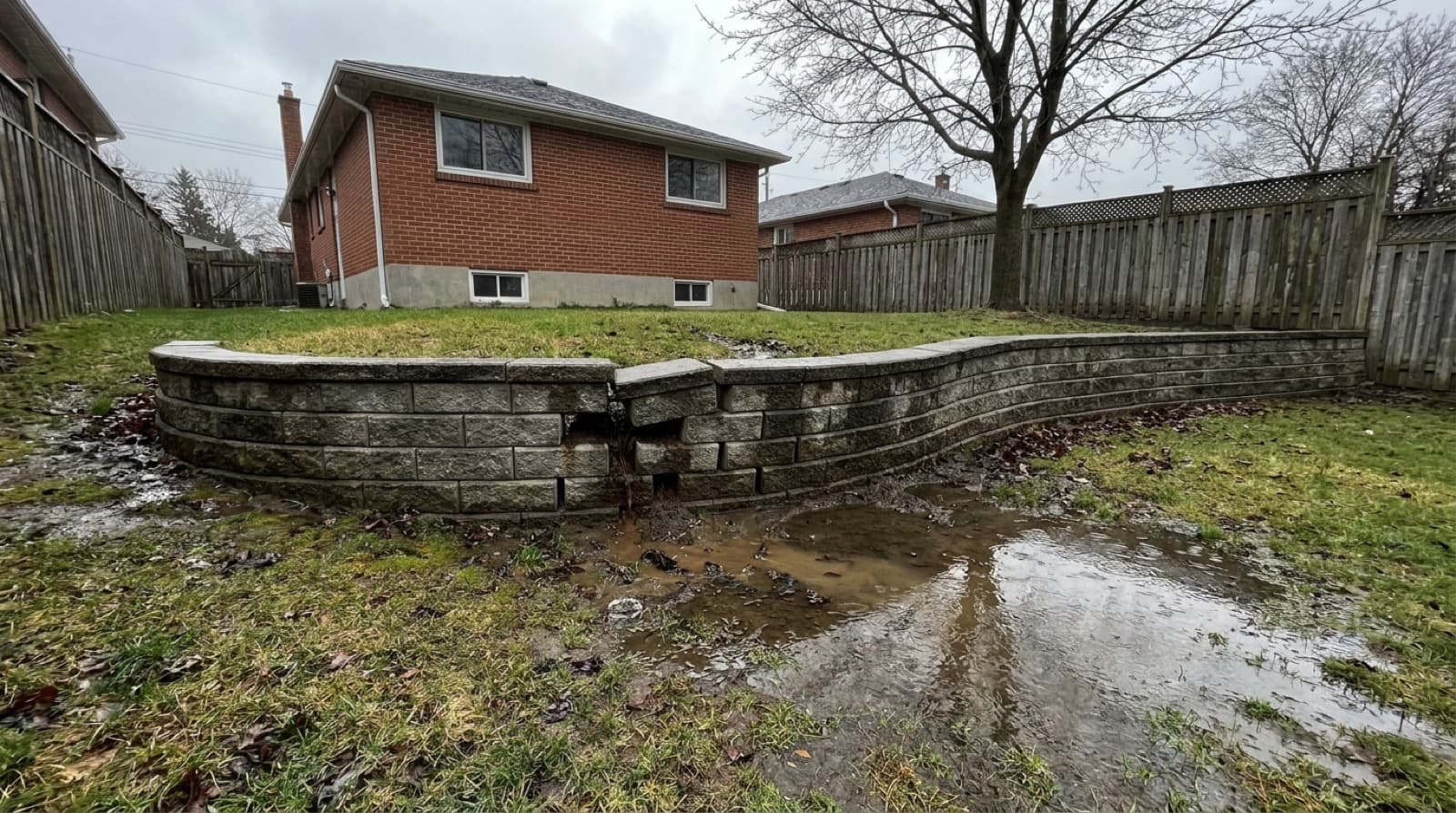
Answer First: Only when a sudden, covered event breaks it. A March 2015 homeowners form that a broker posts as Aviva's excludes retaining walls unless a named event, such as fire, lightning, vehicle impact or vandalism, caused the damage. Square One's June 2025 sample wording covers them but excludes water pressure, freeze-thaw, earth movement, wear and tear and faulty workmanship.
A wall that tips over after a wet spring feels like an accident. On paper, it rarely reads as one. Two real policy wordings show how a retaining wall is treated, what tends to sink a claim, and what a rebuild costs in Toronto if the answer is no.
This is general information, not insurance advice. Policies differ from insurer to insurer and year to year. Read your own wording and call your insurer or broker before you decide anything.
Is a retaining wall covered by insurance in Ontario?
Sometimes, and it depends on two things: whether your policy counts the wall as insured property, and what made it fail.
Start with how insurers define a covered event. The Insurance Bureau of Canada calls a peril "a chance event that is unexpected and accidental as far as the policyholder is concerned." The same page states the flip side plainly: "A home insurance policy is not a maintenance contract."
Keep that second sentence in mind for a retaining wall. A wall that has leaned a little further each spring is the opposite of a chance event. The IBC gives a close cousin as its example of what is not insured: "the rotting of wooden fencing is natural and expected, and therefore, not an insured peril." It is easy to see an insurer reading a rotting timber retaining wall the same way.
Quotable: Home insurance pays for sudden accidents, not slow failure. A retaining wall that leans, bulges and tips over across several Toronto winters points to wear and tear, water pressure or earth movement, and both policy wordings in this guide leave that kind of failure uncovered.
Does your policy treat the wall as insured property?
Check this first, because the two wordings in this guide start from opposite ends.
Square One's sample homeowner wording, dated June 2025, lists "retaining walls" in its definition of "Fences and Landscaping." It insures "all types of direct physical loss or damage" to them. That cover is subject to its exclusions and to a limit printed on your Policy Declaration, the summary page that lists your coverages, limits and deductibles. Square One notes that its wordings "may vary across provinces." Its definitions also list Fences and Landscaping among the items "for which additional insurance can be purchased," so check that your own Policy Declaration actually shows this coverage and a limit.
The comprehensive homeowners form that broker HUB International posts as Aviva's, with March 2015 in its file name, lists retaining walls under "Property not insured." The exclusion reads: "retaining walls, unless the damage is caused by fire, lightning, impact by watercraft, land vehicle or aircraft," or by "vandalism and malicious acts." The form itself does not print the insurer's name, it is an older edition, and Aviva's current wording may differ. It still shows how narrow the cover can be.
| Question | Square One sample (June 2025) | Aviva form (March 2015) |
|---|---|---|
| Is the wall insured property? | Yes, as Fences and Landscaping | No, except for named causes |
| Freezing, thawing, water or ice pressure | Excluded for retaining walls by name | Flood and surface water excluded |
| Earth movement, landslide | Excluded (optional earthquake cover buys back only direct earthquake damage) | Excluded |
| Wear and tear, deterioration | Excluded | Excluded |
| Faulty design or workmanship | Excluded | Excluded |
| Settling, bulging, cracking | Clause names the house and detached structures only | Excluded |
That last row matters. Square One's settling and bulging exclusion is written for "any Building or Detached Structures," and its Detached Structures definition "does not include Fences and Landscaping." Small choices like that are why you read your own policy.
When is a failed retaining wall not covered?
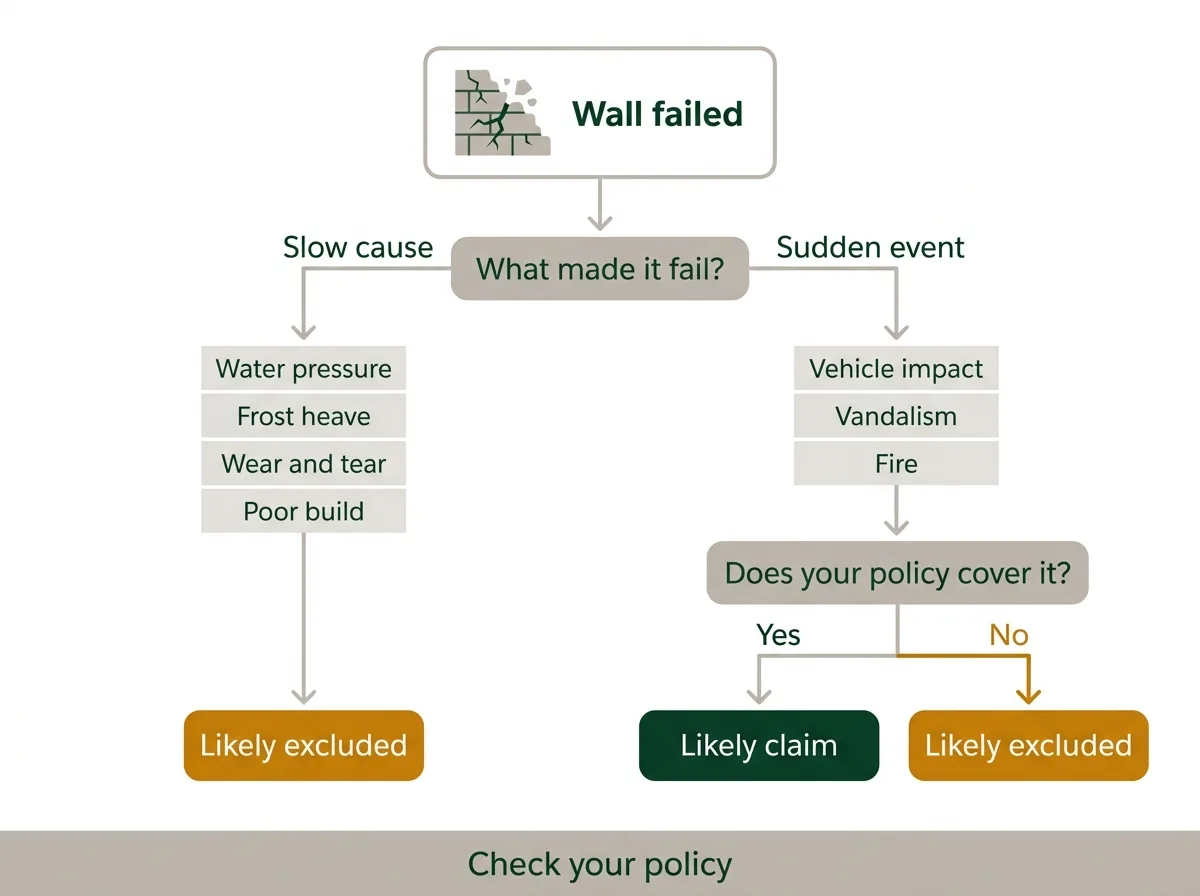
When the cause is slow, predictable or built in. Here is how common causes line up against the wording.
- Water pressure after rain or snowmelt. Square One's sample excludes damage "caused by freezing, thawing, pressure or weight of water or ice" to a list that includes "retaining walls."
- Frost heave. The IBC says damage from freezing outside the home "is not covered, nor is melting or moving snow and ice, and heaving frost." That exclusion carries weight in a city with Toronto's freeze-thaw winters.
- A slope that moves. The IBC lists "Landslides, earthquakes and other earth movements" as generally excluded. Both insurer wordings exclude earth movement too.
- Age and neglect. Square One excludes wear and tear, including "accelerated deterioration resulting from inadequate care over time." The Aviva form excludes "wear and tear, deterioration, defect."
- A poor build. Square One excludes "faulty design, material, workmanship, or an inherent defect." The Aviva form excludes the cost of making good faulty material, workmanship or design.
Square One's exclusions also apply "whether other causes acted concurrently or in any sequence" with the excluded cause. So a storm on the day of collapse may not rescue a claim if water pressure did the real work.
What sudden events can make a claim work?
Short, identifiable events. The Aviva form names them: fire, lightning, impact by a watercraft, land vehicle or aircraft, and vandalism or malicious acts. A delivery truck backing into a front-yard wall on a tight Toronto street fits that list. The IBC's list of typical insured perils also includes "Aircraft or vehicle impact" and "Vandalism."
A falling tree is the case to check. It is not on the Aviva form's short list, while Square One's wording starts from all direct physical loss and then subtracts its exclusions. If the tree came from next door, our guide to a neighbour's tree and Ontario rules explains who owns a boundary tree.
Does overland flood coverage help after a big storm?
Do not assume it. The IBC's flood guidance says overland flooding "is typically not covered by a standard policy," though optional overland flood coverage "is now offered by many insurers for the majority of homes."
Square One's sample defines Inland Flood to include flooding "caused by snowmelt, rainfall" and gives it a separate deductible. Yet the same wording excludes water and ice pressure on retaining walls. It also excludes damage "caused by ground water or rising of the water table." The Aviva form excludes damage "caused directly or indirectly by flood, surface water." If you carry a flood endorsement (an add-on to the base policy), ask your insurer in writing whether it reaches the wall.
Why do Toronto retaining walls fail in the first place?
The causes that sink a claim line up with the build faults installers warn about. Project Landscaping, an Ontario installer, puts it plainly: "Every retaining wall needs drainage behind it. Without it, water pressure builds up and eventually pushes the wall over." The same guide warns that "Clay expands and contracts with moisture," so check what your installer found when they dug.
Renovation Price, a Toronto and GTA cost database, says market-rate labour on structural walls includes "installing weeping tiles to prevent wall blowout from water pressure." A wall built without that drainage tends to fail in the ways the wordings exclude: workmanship, wear or water pressure.
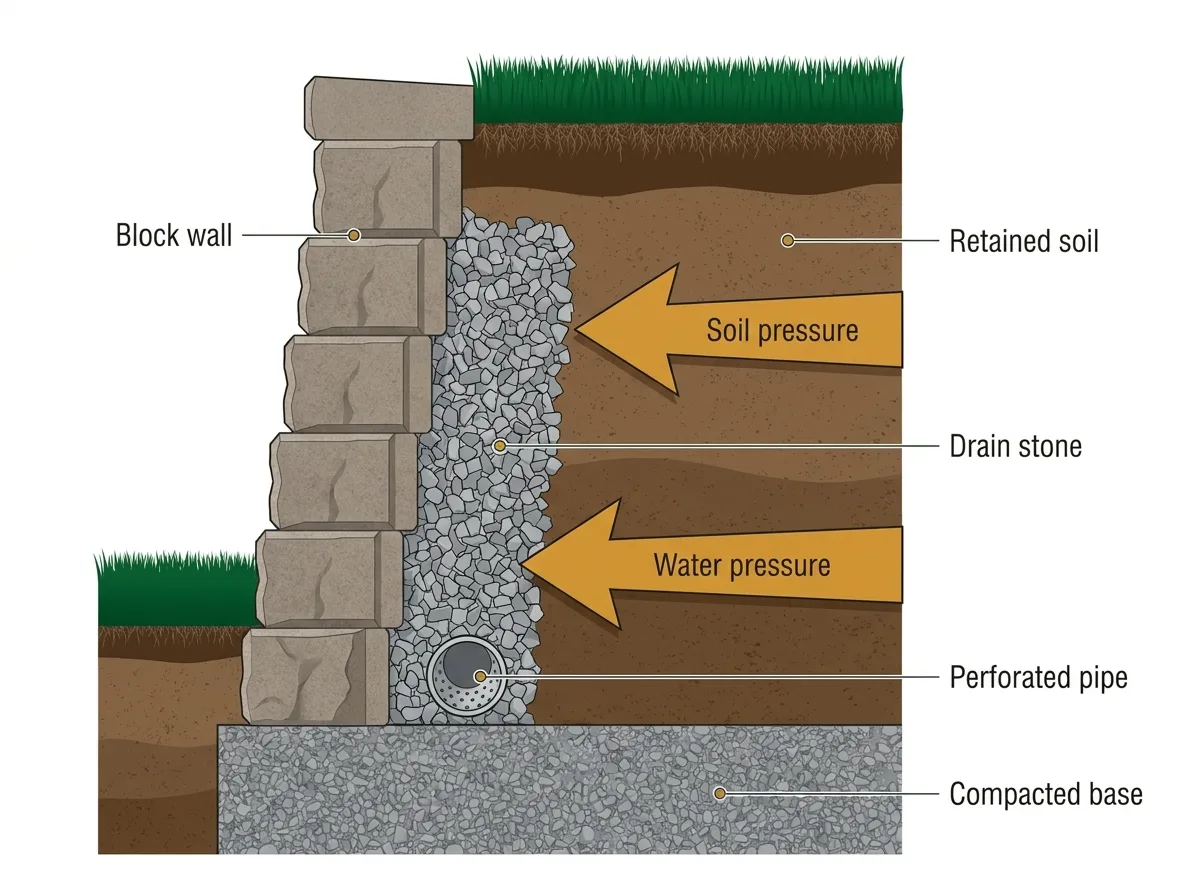
A rebuild on a slope may also need an excavating and site prep crew in Toronto to dig out and regrade before the wall goes back up.
What does rebuilding a failed retaining wall cost in Toronto?
If the claim is denied, the rebuild is yours. These rows come from YardGrade's Toronto retaining wall cost research:
- Installed wall, all materials: Project Landscaping, an Ontario installer, puts it at $25 to $65 per square foot of wall face.
- Labour only, structural wall over 3 ft: Renovation Price gives a GTA market rate of $39 to $65 per face square foot.
- Engineer's stamped drawings for a wall over 1 m: Forty Five Scapes, an Ontario landscaper writing about Simcoe County work, puts engineering stamps at $800 to $1,800. Project Landscaping gives a wider $1,500 to $3,500 for engineering and permit fees together on walls over 1 m.
- Municipal building permit: Project Landscaping lists $200 to $500+, varying by municipality.
- Basic drainage behind the wall: Project Landscaping lists $5 to $10 per linear foot for perforated pipe and gravel.
From the data: Take a wall 4 ft high and 50 ft long, which is 200 sq ft of face. At Project Landscaping's $25 to $65 per square foot, the rebuild runs $5,000 to $13,000 before any engineering. That brackets Project Landscaping's own $8,000 to $12,000 figure for a natural stone wall of the same size. We track 37 retaining wall firms in Toronto.
If water pressure brought the wall down, compare quotes on the drainage and the base as well as the block. You can browse the retaining wall companies we track in Toronto and read their public reviews before you call anyone.
What should you do before you call your insurer or broker?
Move quickly and keep evidence. The IBC's claims guide says you must report a claim "as soon as possible," and adds:
- Photograph everything. "Take photos of any damaged or destroyed items."
- Limit further damage. "Know that your policy requires you to act to limit any further damage." Keep people and cars away from a leaning wall.
- Do not clear the rubble yet. "Confirm with your insurer before disposing of damaged property."
- Watch the paperwork clock. A proof of loss is your signed statement of what was damaged and what it costs. "Typically, a proof of loss must be completed and returned to your insurance company within 30 days."
YardGrade is free for homeowners; contractors pay for the introductions we make, as our about page explains, and no company can pay for a better grade.
Write down when you first noticed the lean and what happened in the days before it moved. Sudden or slow is the question both wordings in this guide turn on, and dates help answer it.
Whether the claim is paid or not, you will need a rebuild price you can trust. Request a quote to get quotes from up to 3 local pros, compare them side by side, and share your details only with the one you pick.