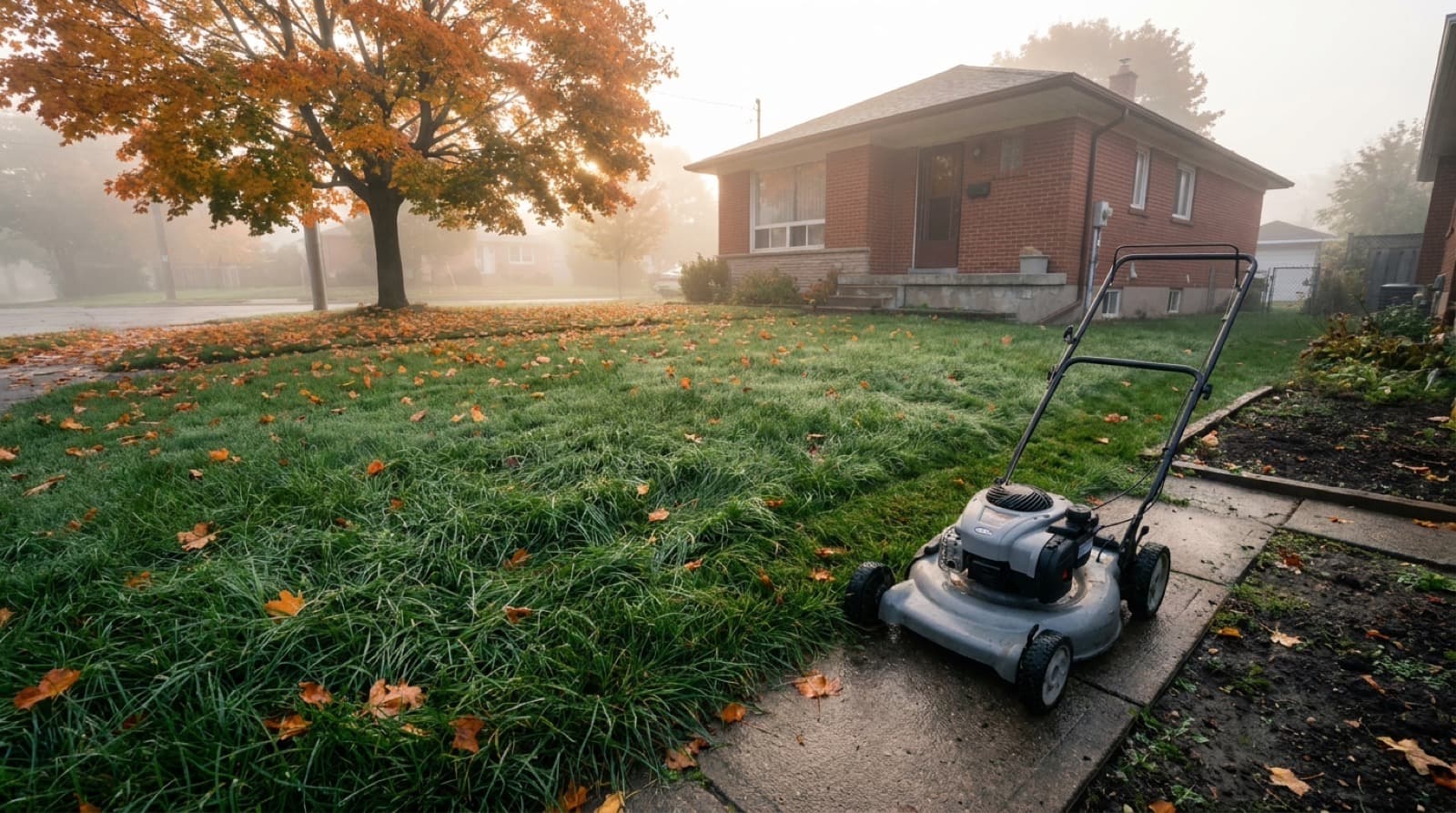
Answer First: No, not if you can wait. Wet grass clumps, clogs the mower and leaves mats that smother the lawn. Soft soil ruts and compacts under the wheels. Fungus rides on wet debris and equipment, and wet footing can put your foot near the blade. Mow once the blades are dry and the ground is firm.
A wet spring or a dewy fall morning makes this a weekly question in Toronto. The grass keeps growing in the rain, so the skill is knowing when the lawn is dry enough, and how to cut safely when a wet week leaves no choice.
Should you mow wet grass at all?
Not by choice. The extension sources we checked that address it agree, in plain words. University of Maryland Extension, in its guide to diseases of home lawns, says to "use clean equipment and do not mow wet grass." Illinois Extension calls it "never advisable to mow when the grass is wet." Toro's own operator manual for its 21-inch Recycler mower tells owners to "avoid mowing in wet conditions."
A wet cut hurts the grass, the soil and the person pushing the mower in one pass. The exception is a long rainy stretch where waiting does more harm, and that case has its own rules, covered below.
Why shouldn't you mow the lawn when it is wet? Five things go wrong
- Clumping and clogging. Toro's manual warns that wet grass and leaves clump on the yard and "can cause the machine to plug or the engine to stall." Illinois Extension adds that mulching mowers (mowers that chop clippings fine and drop them back on the lawn) do not work at peak efficiency when the lawn is wet.
- Mats that smother the lawn. The clumps land as heavy wet piles. Health Canada's lawn care page says that under wet spring conditions you should remove clipping layers thicker than 0.5 cm so they do not smother the grass.
- Ruts and compaction. Soft ground gives way under wheels and feet (more on clay below).
- Disease spread. Fungus fragments move on wet debris and equipment.
- Slipping. Wet grass is poor footing, and a slip near a spinning blade is how people get hurt.
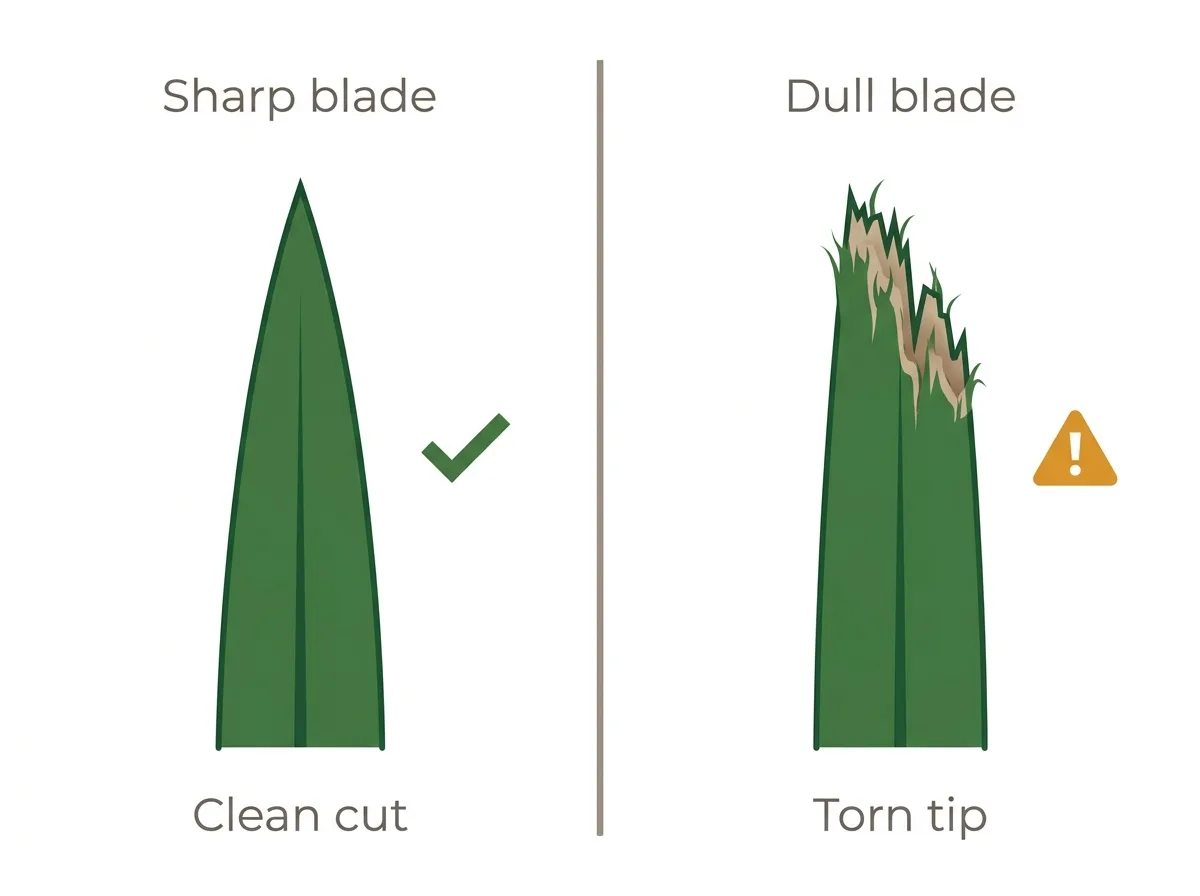
A related problem is the torn blade tip. The sources are specific here: University of Maryland Extension says "dull mower blades tear and bruise grass leaves, giving fungi an opportunity to start infections." Health Canada says grass "recovers more quickly and easily from a clean cut than when it's torn." Neither says rain alone tears grass. But torn tissue on a leaf that stays wet is exactly the combination fungi need, so a sharp blade matters most in a wet season.
How does mowing wet grass spread lawn disease?
The mower becomes a carrier. University of Maryland Extension explains that fungus fragments get "moved around in infected leaf debris on equipment" and also travel in splashing water. Wet clippings stick to the deck, the wheels and your shoes, and they get dropped somewhere else on the lawn.
Time spent wet matters too. The same guide says that in mild temperatures, when fungus is plentiful, leaf disease outbreaks can occur when leaves stay wet for 12 to 24 hours. Mowing does not create that wetness, but it spreads infected debris while it lasts.
Quotable: University of Maryland Extension gives two rules in one sentence: use clean equipment, and do not mow wet grass. Its reason is that fungus fragments travel on equipment and in splashing water.
The fix is housekeeping. The extension's lawn maintenance guide says to clean debris out of the mower base "to minimize the spread of diseases." After a damp cut, scrape the deck before the clippings dry on.
Why is wet mowing worse on clay soil?
Because clay packs down more easily, and wet soil packs the most. University of Maryland Extension's lawn maintenance guide says "clay compresses more readily than sand" and that "wet soil is particularly vulnerable to compaction." Rutgers Cooperative Extension puts it as a rule: "Dry soil will bear weight better than moist or wet soil, so avoid loads on wet ground." It also lists persistent tire ruts as a sign of compaction.
Not sure what your yard is? The City of Toronto's Get Growing guide gives a quick test. Squeeze a handful of moistened soil into a ball. If it holds together in a tight ball, it is high in clay. The same guide warns that clay soil "tends to drain poorly and can become hard and compacted."
Compaction outlasts the rain. Rutgers notes that compacted soil impedes root growth and that water ponds where it cannot soak in, and it warns that wetter soils compact to greater depths that are harder to fix. Core aeration (pulling small plugs of soil out of the lawn so air and water can get in) helps, but it is a paid fix, listed in our lawn care cost guide. That is a poor trade for one Saturday's cut that could have waited a day.
Is it dangerous to mow wet grass?
Yes, and Toro's manuals say so directly. Toro's 21-inch Recycler manual warns: "Wet grass or leaves can cause serious injury if you slip and contact the blade." On a push mower, your feet are the risk, and a slip on a wet slope puts a foot close to the deck.
Riding mowers carry a different risk. Toro's TimeCutter manual, for a zero-turn riding mower (one that steers by driving its two rear wheels at different speeds), says that operating on wet grass, across slopes or downhill "may cause the machine to lose traction," and that "the machine can slide even if the drive wheels are stopped." A sloped front yard is the worst place to test that.
A plugged deck adds one more hazard. When wet grass jams the chute, the tempting move is to reach in. Toro's push-mower manual says to shut off the engine and "wait for all moving parts to stop" before unclogging the machine.
How can you tell if the lawn is dry enough to mow?
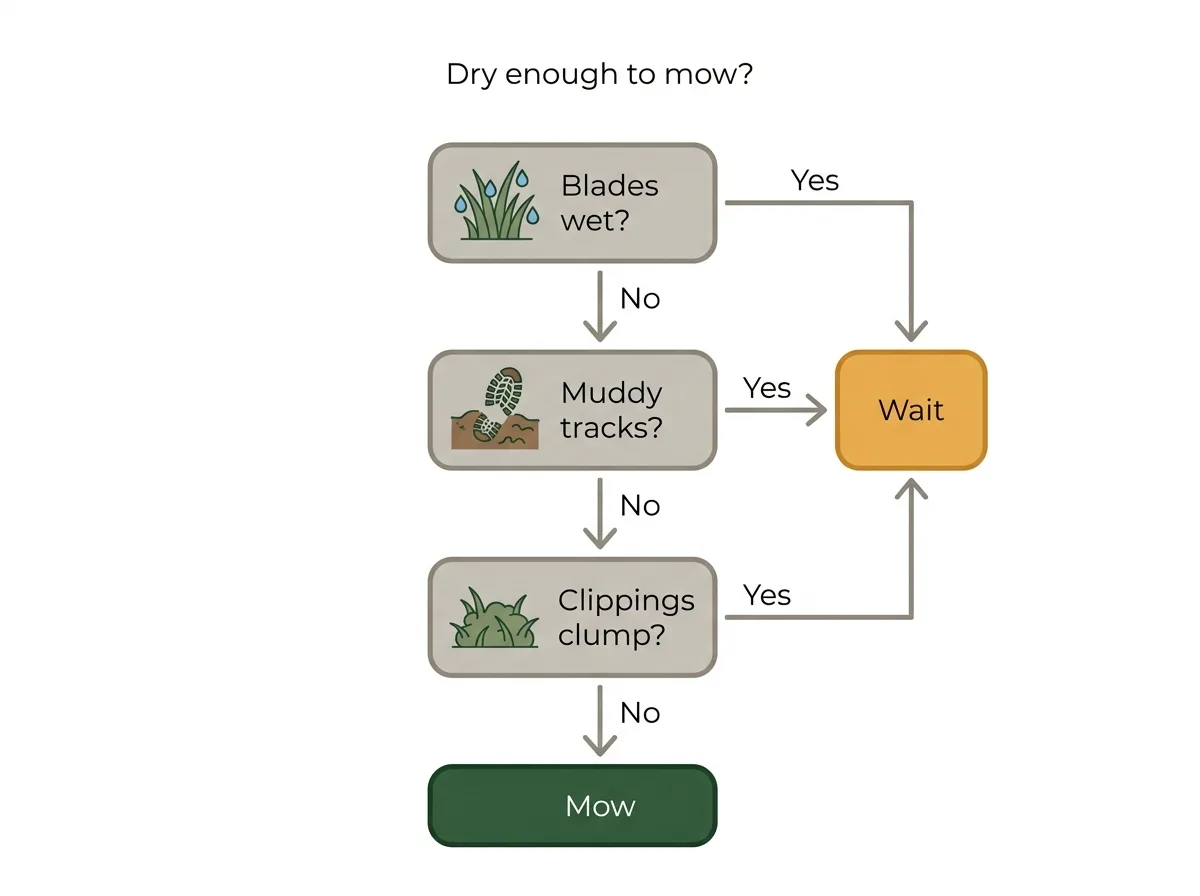
Run three quick checks before you pull the cord. If any answer is yes, wait.
- Are the blades wet? Brush the grass with your hand. If your palm comes up wet, it is too early. Purdue's turf program suggests mowing in the afternoon, when the leaf blades are dry, to reduce clumping.
- Does the mower leave muddy tracks? Purdue treats muddy tire tracks as the sign to switch to a push mower so you do not rut the soil. If you can wait instead, wait.
- Do the clippings clump? Cut a short test strip. If it leaves wet clumps, come back later.
For fall dew, you do not always have to wait for the afternoon. University of Maryland Extension suggests knocking dew off by dragging a garden hose, turned off, across the lawn. It also notes that mowing can remove dew, "but the wet grass can clump and interfere with mulching mowers." That is why the hose comes first.
What if it rains all week in a Toronto spring or fall?
Then you cut carefully instead of skipping. Toronto requires owners to cut turfgrass once it grows past 20 cm. The City's turfgrass bylaw page lists a $500 fine for failing to do so under provision 489-2A. This is a plain summary, not legal advice. Check the City's page for your own situation.
Purdue's turf program has a short list for mowing after a long rainy stretch:
- Set the mower higher, especially if the grass is taller than usual.
- Use side discharge (the chute that throws clippings out the side) instead of mulching, since mulching mowers are prone to clogging.
- Use a walk-behind push mower on wet areas "to avoid making ruts in the soil and permanently damaging the turf."
- Accept that one cut may take more than a third of the blade. Purdue says this may be necessary in periods of frequent rain with little to no long-term harm, as long as it stays the exception.
After the cut, deal with the clippings. The City of Guelph suggests taking two passes or using a rake to break up clumps. Purdue suggests bagging if clippings sit on top of the turf, and Health Canada's 0.5 cm limit tells you when a layer is too thick. Then sharpen the blade if you have not this season, because wet weeks are when a clean cut counts. For the rest of the spring routine, see our spring lawn care checklist for Toronto.
Does a wet week change what lawn mowing costs in Toronto?
It can change which price you pay. Lawn services price by visit and by lawn size. Absolute Home Services, an Ontario company, publishes this per-visit guide and says the average suburban lawn costs "around $60 per visit":
| Lawn size | Price per visit (Absolute Home Services) |
|---|---|
| Small, under 2,000 sq ft | $50 to $55 |
| Medium, 2,000 to 4,000 sq ft | $55 to $75 |
| Large, 4,000 to 8,000 sq ft | $75 to $100 and up |
The same guide puts standard seasonal lawn maintenance (20 to 25 visits, April to October) at $1,200 to $1,800. Our Toronto lawn care cost guide collects more price points with their sources. If rain pushes your weekly cut back, ask your provider two things up front. Is a visit on a wet day moved or skipped? And does the next cut on long grass bill at the weekly rate or the one-time rate? Our lawn mowing cost calculator runs the season math for your lot.
From the data: We track 233 companies in Toronto's lawn care category, counted on September 22, 2026. Of those, 206 have a Google rating with at least 3 reviews, and they average 4.76 stars. Ratings will not tell you a crew's rain-day policy, so put that question in writing when you compare quotes.
YardGrade is free for homeowners; contractors pay for the introductions we make, as our about page explains, and no company can pay for a better grade. Browse Toronto lawn care companies by rating and reviews, or request quotes from up to 3 local pros and compare their answers side by side.