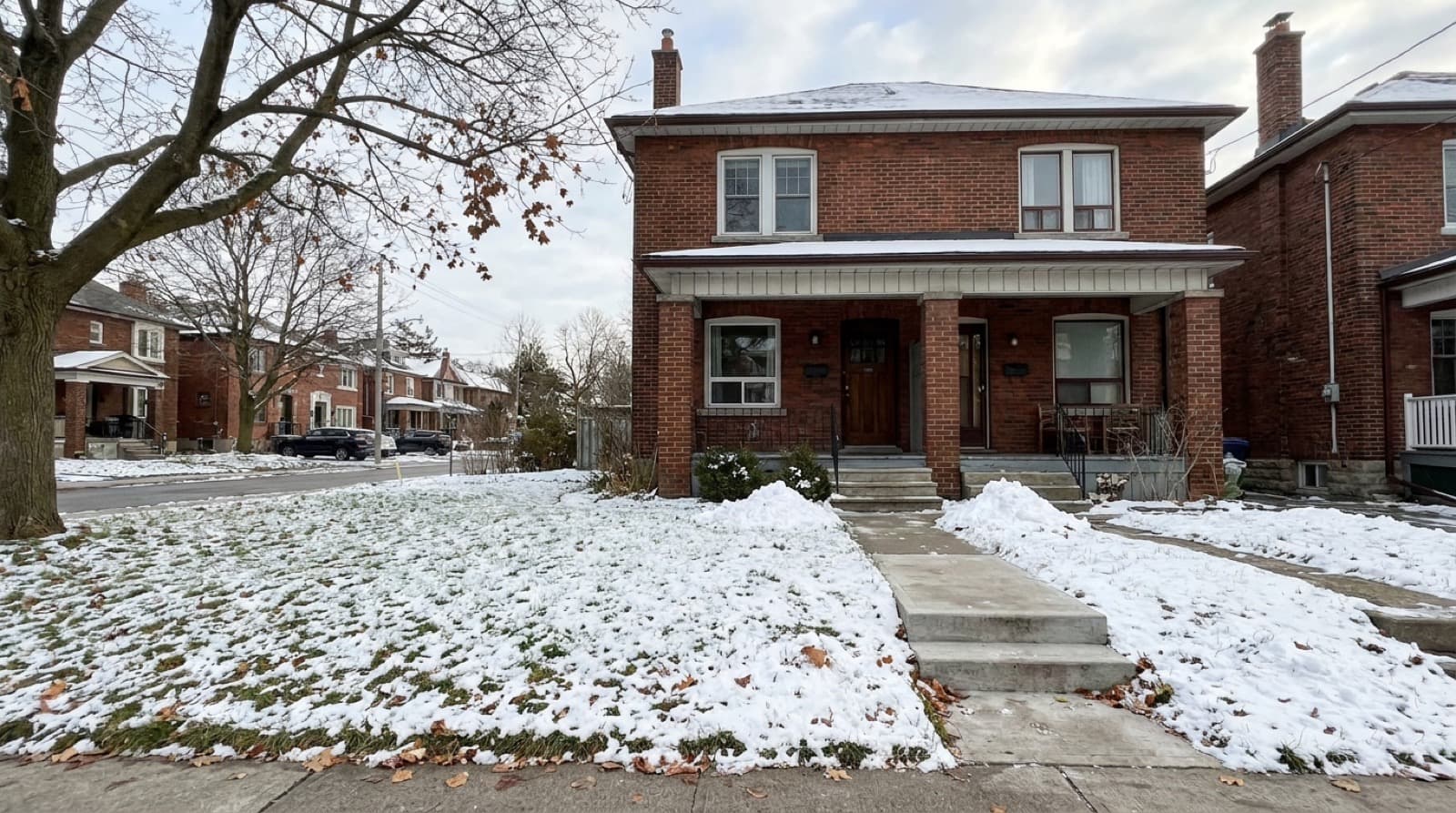
Answer First: In an Ontario rental, mowing the lawn and clearing snow are the landlord's job by default. The Residential Tenancies Act makes the landlord maintain the whole residential complex, and the Landlord and Tenant Board's guideline says a lease clause handing that upkeep to the tenant would not be enforceable. The tenant owes ordinary cleanliness and repair of damage they cause.
That surprises plenty of people renting a whole house in Toronto, where the tenant watches the grass grow and the landlord may live across the city. Here is what each official source says, and where it stops.
This is general information, not legal advice. The Landlord and Tenant Board (LTB) decides disputes between landlords and tenants, and a lawyer or legal clinic can read your actual lease.
Is the landlord responsible for lawn mowing in Ontario?
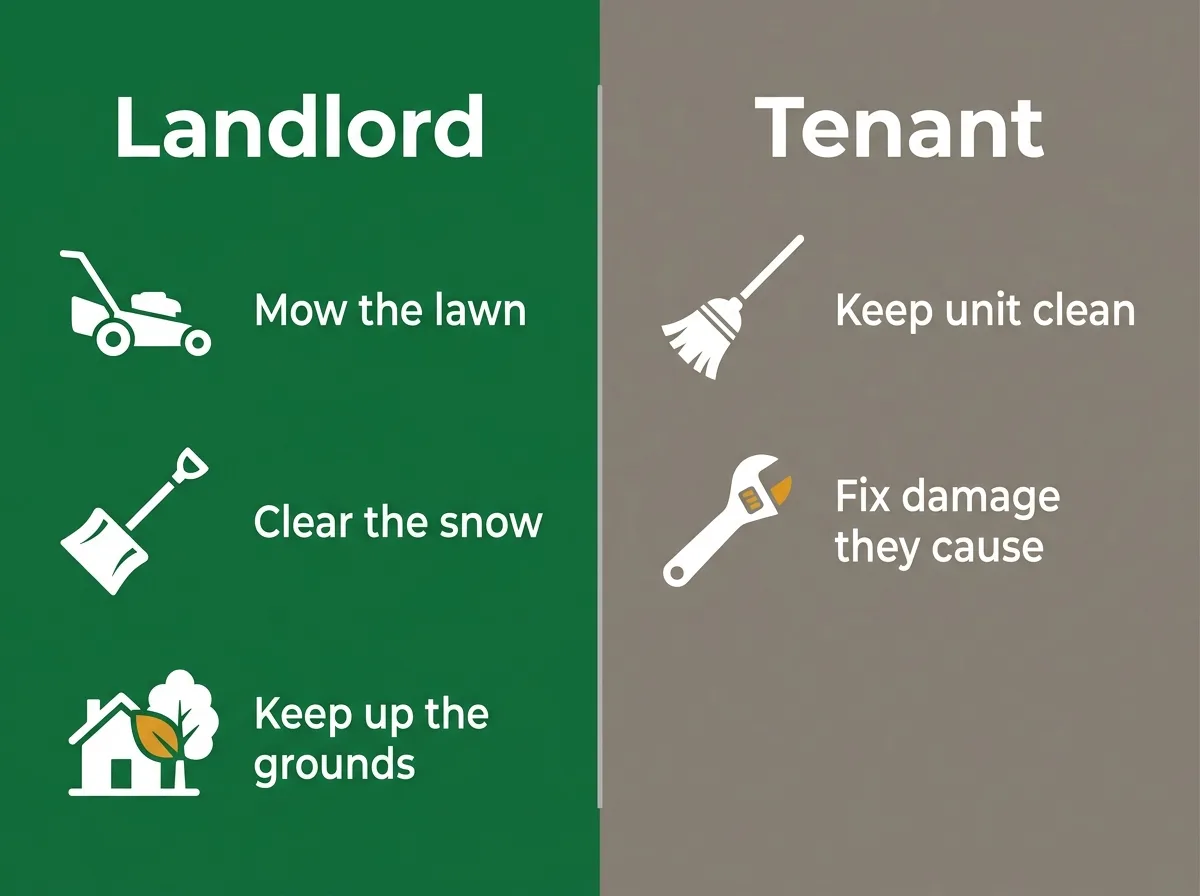
Yes. Section 20 of the Residential Tenancies Act, 2006 says a landlord "is responsible for providing and maintaining a residential complex, including the rental units in it, in a good state of repair and fit for habitation," and for meeting the health, safety, housing and maintenance standards that apply to it. The duty holds even if the tenant knew about the problem before signing.
The phrase that matters is "residential complex." It is wider than the apartment. The LTB's Interpretation Guideline 5, on maintenance, says the complex includes "the lobby, hallways, stairwells, laundry facilities, parking areas, exterior grounds, recreational facilities, etc." A front lawn is exterior grounds. A driveway is a parking area. Both sit on the landlord's side of the line.
The type of rental does not change this. A basement unit in a Scarborough bungalow, the upper floor of an east-end semi and a whole detached house fall under the same section. The Act has no separate yard rule for any of them.
Who clears the snow at a Toronto rental?
Also the landlord, for the same reason. The driveway, front walk, steps and parking pad are part of the residential complex, so keeping them usable in winter falls under the section 20 duty to maintain the complex and meet health and safety standards.
Toronto's own rules name the owner as well. The City's sidewalk clearing page says property owners are responsible for clearing ice and snow from private property, including driveways, parking spaces, steps, ramps and landings, within 24 hours after snowfall ends. The public sidewalk works differently. When less than 2 cm falls, residents and businesses clear the sidewalk next to their property within 12 hours of the end of the snowfall. At 2 cm or more, City crews clear all public sidewalks.
One more rule binds whoever holds the shovel. The same page says snow must not be pushed onto sidewalks, roads or bike lanes, and doing so can bring a fine of $500 plus a $110 victim surcharge (a provincial charge added on top of the fine).
Is lawn maintenance tenant responsibility if the lease says so?
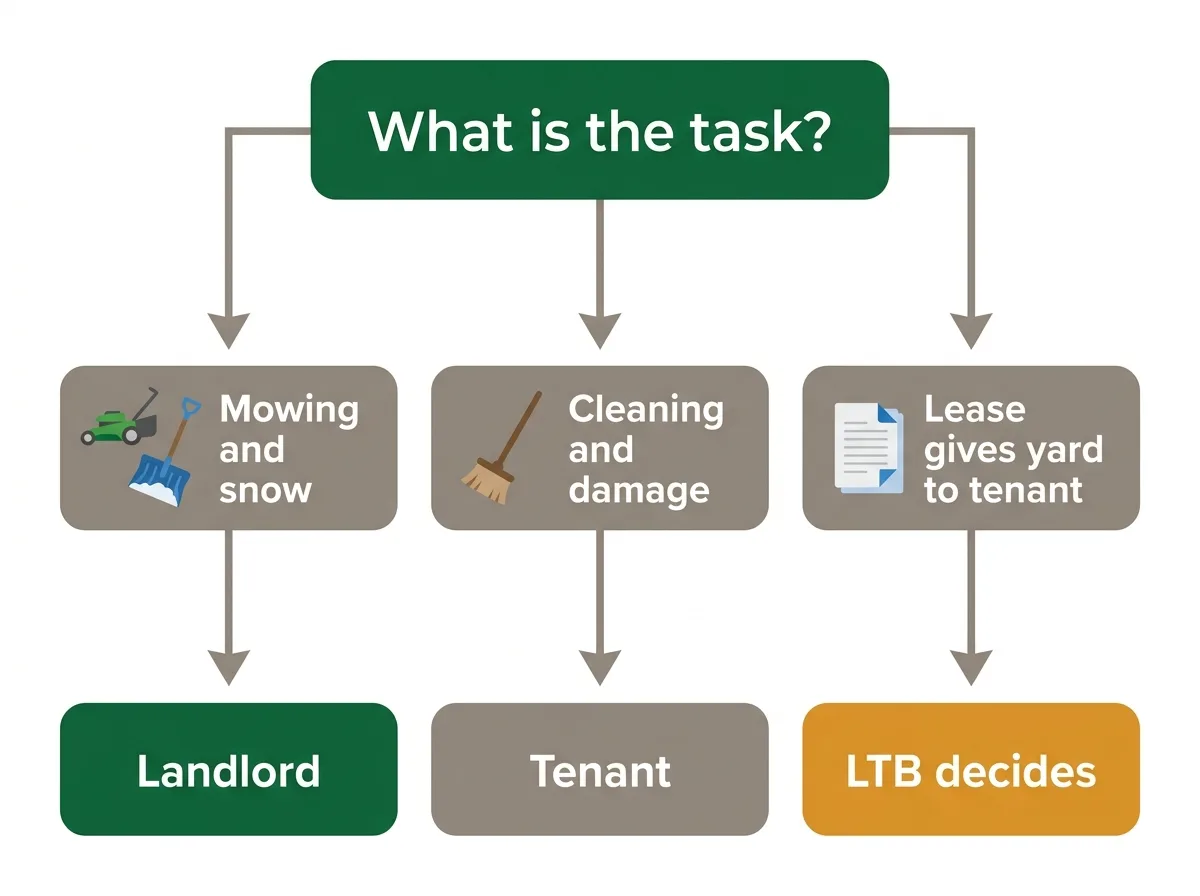
Usually not, according to the LTB's own guidance. Guideline 5 puts it directly: "If a tenant agreed in a lease to assume the responsibility to maintain any part of the unit or complex, beyond ordinary cleanliness and damage, this would not be enforceable." It describes the purpose of the Act as making landlords responsible for their complexes, "and not to limit their obligations by transferring them by agreement to the tenant."
The Act backs this up in section 4, which says a provision in a tenancy agreement that is inconsistent with the Act or the regulations "is void."
Two honest limits apply.
A guideline is not law. It is the LTB's usual reading of the Act, not a statute. The guideline says itself that a Member (the Board adjudicator who hears a case) "is not required to follow a Guideline and may make a different decision depending on the facts of the case."
The courts have left some questions open. Miaskowski v. Persaud, 2015 ONCA 758 was a slip-and-fall case at a rented house. In it, the Court of Appeal for Ontario wrote that "it is arguable" that section 33 "imposes an obligation on the tenant to remove snow." It pointed to an earlier case where the tenant had cleared snow before and believed it was their job. The court also said that whether the lease in that case freed the landlord of the section 20 duty was a genuine issue for trial. It sent both questions to trial rather than deciding them.
So a tenant renting a whole house who has always shovelled the walk should not assume the rule above settles every case. If that arrangement falls apart, the LTB (or a court) decides on the facts.
Quotable: Under Ontario's Residential Tenancies Act, the landlord maintains the residential complex, including its exterior grounds, and the Landlord and Tenant Board's Guideline 5 says a lease clause making the tenant maintain any part of it, beyond ordinary cleanliness and damage, would not be enforceable.
What does Ontario's standard lease say about lawn care and snow removal?
Nothing by name. The Standard Form of Lease (form 2229E), required for most tenancies entered into on March 1, 2021 or later, has no line for lawn care or snow removal. Its services section lists gas, air conditioning, additional storage space, on-site laundry and guest parking, then leaves blank "Other" lines.
Anything else goes in Section 15, Additional Terms. The form sets the limit in plain words: "An additional term cannot take away a right or responsibility under the Residential Tenancies Act, 2006." A term that conflicts with the Act "is void (not valid or legally binding) and it cannot be enforced." The form also suggests getting legal advice before agreeing to extra terms.
So a yard or snow arrangement can go into Section 15 as a record of what you agreed. By the form's own wording, it cannot take away the landlord's duty under section 20, although the court case above shows that exact point can still end up argued at trial.
What is the tenant actually responsible for?
Two things, and both are narrow. Section 33 makes the tenant responsible for "ordinary cleanliness of the rental unit," unless the tenancy agreement has the landlord doing the cleaning. Section 34 makes the tenant responsible for repairing "undue damage to the rental unit or residential complex caused by the wilful or negligent conduct" of the tenant, another occupant, or a person the tenant let in.
Because the yard is part of the residential complex, a tenant who damages the lawn, a fence or the walkway on purpose or through carelessness can be made to repair or pay for it. The standard lease adds that this does not include damage from normal use over time, which it calls "wear and tear." Grass growing is not damage, and neither is snow falling, although the court case in the section above shows snow can still end up argued as a cleanliness duty.
What do Toronto bylaws say about long grass at a rental?
The City's Turfgrass and Prohibited Plants page says "owners or occupants of private properties are required to cut the turfgrass on their lawn whenever the growth exceeds 20 centimetres in height," and it lists a $500 fine for failing to cut. If property owners do not comply, the City can do the work and add the cost to the property tax bill.
So the bylaw names both owners and occupants, while the bill for City work lands with the owner. Between landlord and tenant, the section 20 duty still sits with the landlord.
What does a season of mowing and snow clearing cost a landlord?
Published contractor prices give a rough scale. Absolute Home Services, an Ontario company, lists standard seasonal lawn maintenance (20 to 25 visits, April to October) at $1,200 to $1,800. For winter, the same company lists an all-inclusive contract from November through March at $575 to $1,725, and Cahill Landscaping, a Toronto company, says full season plans "can range from $300 to $600 or more." At the low ends of Absolute's two ranges, that is about $1,775 a year ($1,200 plus $575, our arithmetic) before 13% HST (Canada Revenue Agency).
Our lawn care cost page and snow removal cost page collect more Toronto price points with their sources. You can size the grass side for your own lot with the lawn mowing cost calculator, and weigh a contract against paying per storm in our seasonal vs per-visit snow removal comparison. For the tax side of these bills, see whether lawn care is tax deductible in Canada.
From the data: YardGrade tracks 233 Toronto companies tagged for lawn care and 175 tagged for snow removal, and 50 of them carry both tags (YardGrade directory data, July 2026). That group of 50 is the short list if a landlord wants one company for the grass in summer and the driveway in winter. YardGrade is free for homeowners and landlords; contractors pay for the introductions we make, as our about page explains, and no company can pay for a better grade.
What can a tenant do if the yard or walk is neglected?
Tell the landlord first, and keep a copy of what you sent. The standard lease says a tenant with a maintenance problem "should let the landlord know," and "if needed, the tenant can apply to the Landlord and Tenant Board." The LTB's maintenance and repairs brochure names the application: the Tenant Application about Maintenance, Form T6. Guideline 5 lists what the Board can order if it finds a breach: the work done, an abatement of rent (a refund or reduction of rent), or an end to the tenancy.
What a tenant should not do is stop paying. The same lease states that "the tenant must pay their rent, even if they have problems with the maintenance and repair of their unit or property."
For landlords, the simplest fix is a crew on a schedule: browse Toronto lawn care companies and Toronto snow removal companies by rating and reviews.
Own a Toronto rental and need the lawn and the driveway covered? Request quotes for mowing, snow clearing or both, and compare quotes from up to 3 local pros side by side. Only the pro you choose gets your contact details.