
Answer First: Lawn care is deductible in Canada when it keeps up a property that you rent out or use for business, but it is not deductible for a personal home. A landlord can claim routine lawn care and snow removal as current expenses with the Canada Revenue Agency, and you can also deduct landscaping of the grounds in the year you pay for it (Form T776). When the home is only your residence, with no rental or business use, lawn care is a personal expense that cannot be claimed.
The deciding point is whether the lawn helps bring in income. Grass in front of the home you occupy is a personal cost, just like repainting your bedroom. That same grass in front of a home you rent to a tenant is a cost of running the rental, and the CRA treats it accordingly. Below, the three situations most GTA homeowners actually face are each an application of that one idea.
This guide explains in plain terms what the CRA rules say, but it is not tax advice for your return. Before you file, check your own circumstances with an accountant.
When is lawn care tax deductible in Canada?
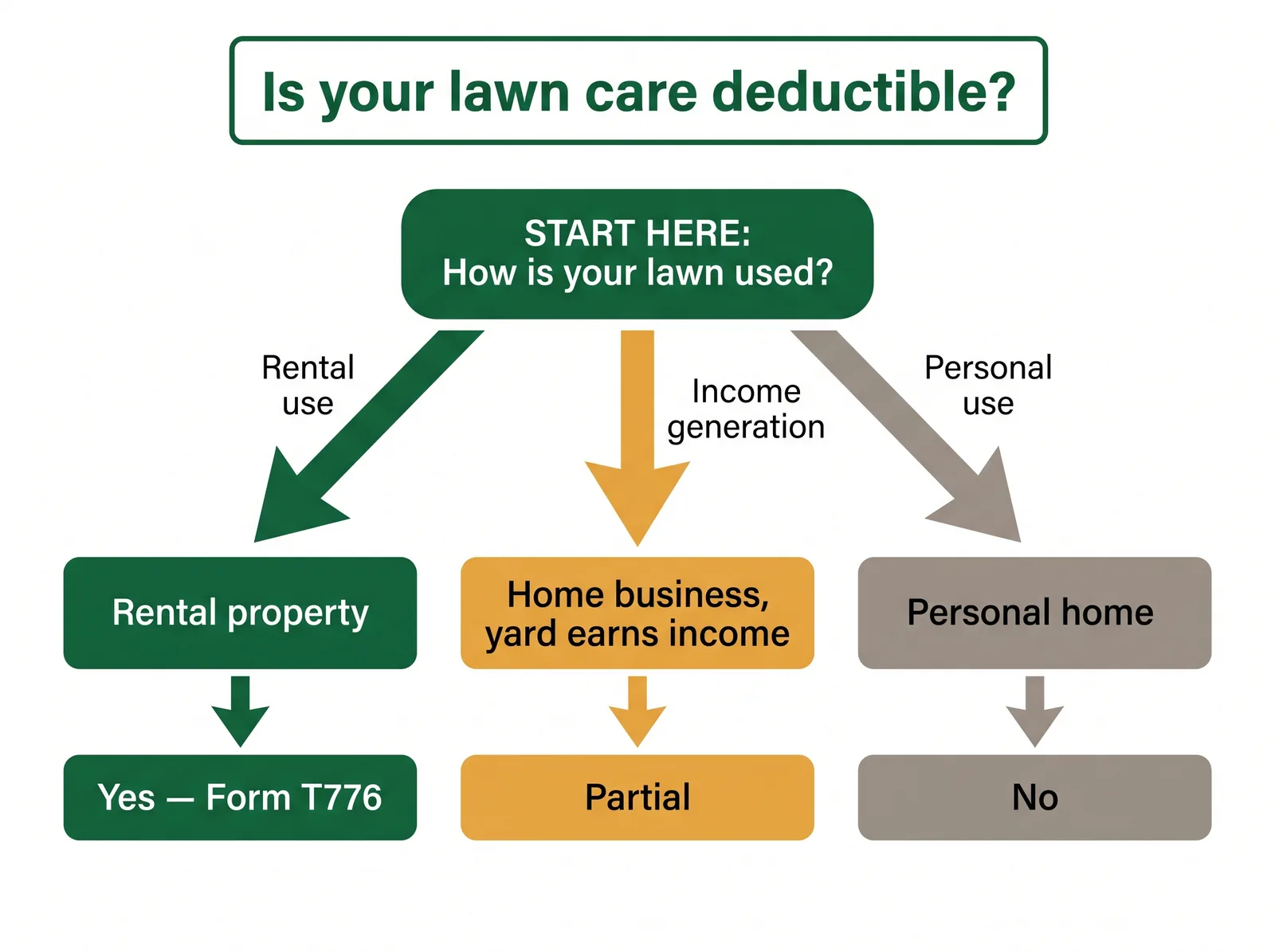
Lawn care can be deducted in two situations and cannot be deducted in a third. The table below shows the complete answer at a glance, and the sections that follow explain each row.
| Your situation | Deductible? | How the CRA treats it | Where it goes |
|---|---|---|---|
| You rent out the property (or a self-contained unit) | Yes | Routine lawn care = current expense; landscaping deductible in year paid | Form T776 |
| You run a business from home | Rarely | Business-use-of-home covers the work space inside, not the yard | Form T2125 (if it qualifies at all) |
| It is your personal residence, no rental or business use | No | Personal expense | Not deductible |
Quotable: The CRA's rule for deducting lawn care does not depend on where the grass sits; it depends on whether that grass contributes to earning income. A lawn at a rental property is deductible, while the identical lawn at your own home is a personal expense.
Lawn care on a rental property: deductible
When you rent out the property, the CRA places routine lawn maintenance in the same category as any other cost of keeping the unit rentable. Regular lawn care, snow removal, and property management fees are current expenses. They keep the property in its existing condition, so you deduct the full amount from that year's rental income on Form T776. Whether the landlord or the tenant has to do that mowing and shovelling in the first place is a separate question, covered in lawn and snow: landlord or tenant in Ontario.
Landscaping receives a specific, more generous rule. Normally, a cost that improves a property rather than maintaining it counts as a capital expense, deducted gradually over years through capital cost allowance. The exception is landscaping the grounds. The CRA says you can deduct the cost of landscaping the grounds around your rental property in the year you paid the cost, even if you use the accrual method for your rental income, and the soft-cost rules that capitalize other construction expenses do not catch this cost.
Current expense is a cost for maintaining a property in its existing condition (mowing, fertilizing, seasonal cleanup), and you can deduct it in full in the year you pay it. Capital expense is a cost for improving the property or extending its life, and you deduct it gradually through capital cost allowance. For rental lawns, routine care and landscaping are both deductible now.
Quotable: For a rental property, the CRA permits you to deduct the cost of landscaping the grounds in the year you pay for it, rather than making you spread the deduction over several years. This unusually favourable rule does not apply to most other property improvements.
A seasonal contract is therefore a real tax event for a landlord in the GTA. In Toronto, a seasonal mowing contract costs about $1,500 and a full-service package about $2,100, and you reduce your taxable rental income by the entire amount, HST included, in the year you pay it. The actual tax saved depends on your own marginal rate; that is a question for your accountant, not something a lawn care price can answer.
What a season of lawn care actually costs a landlord
A deduction is only as valuable as the invoice that supports it, and landlords usually pick one of two billing structures. Price both before you sign, because they create very different paperwork.
Toronto lawn care prices break down like this:
| What you are buying | Range | Typical | Billed |
|---|---|---|---|
| Weekly mowing, mid-size lot (2,000–4,000 sq ft) | $45–$75 | $60 | per visit |
| Monthly weekly-mowing plan | $160–$200 | $180 | per month, over an 8-month season |
| Seasonal mowing contract (April–October, 20–25 visits) | $1,200–$1,800 | $1,500 | per season |
| Full-service package (mowing, fertilizer, weed control) | $1,800–$2,500 | $2,100 | per season |
Extend the per-visit rates across a full season and the contrast becomes plainer. A mid-size Toronto lot charged $45 to $75 per visit, over the 20 to 25 visits a season contract covers, totals between $900 and $1,875. The seasonal contract for the same work runs $1,200 to $1,800. Since the ranges overlap almost completely, the decision seldom comes down to overall cost.
What matters is the documentation. With a seasonal contract, you get one dated invoice for a set amount in a set tax year, which fits exactly what the T776 process expects. Per-visit billing creates twenty-odd small receipts that you must keep, add up, and be ready to show if the CRA asks. For a landlord, that difference is usually more valuable than a few dollars in either direction.
From the data: The price rows above come from YardGrade's researched Toronto lawn care pricing, read August 2026. The season totals come from multiplying that per-visit range by the 20 to 25 visits the seasonal row covers, so you can check the arithmetic yourself.
Lawn care at your personal home: not deductible
Lawn care counts as a personal expense if you own and occupy the home and no part of it produces rental or business income. The CRA allows no deduction for upkeep of your own residence, and the lawn is treated no differently from the roof or the driveway. Whatever the amount you spend, landscaping your own backyard is not a line on your tax return.
Ordinary homeowners do not get an Ontario or federal credit that changes this. The occasional "is my lawn deductible?" hope generally comes from US content or from rental and business rules that have been applied to the wrong situation. For a personal residence, the straight answer is no.
Lawn care and a home office: usually not
People most often assume lawn care becomes deductible when they operate a business from home, but the rules are narrowest there. Business-use-of-home deductions relate to the work space inside your home. You can claim a reasonable share of heating, electricity, insurance, cleaning materials, property taxes, mortgage interest and capital cost allowance, calculated by dividing the work space area by the total area of the home.
The yard does not count as work space. Lawn care is an outside expense that is mostly personal, so it usually stays out of the business-use-of-home calculation even when you have a valid home office. Two rules support this: the deduction depends on the portion of the home actually used for business, and business-use-of-home expenses cannot create or enlarge a business loss; unused amounts carry forward to a later year instead.
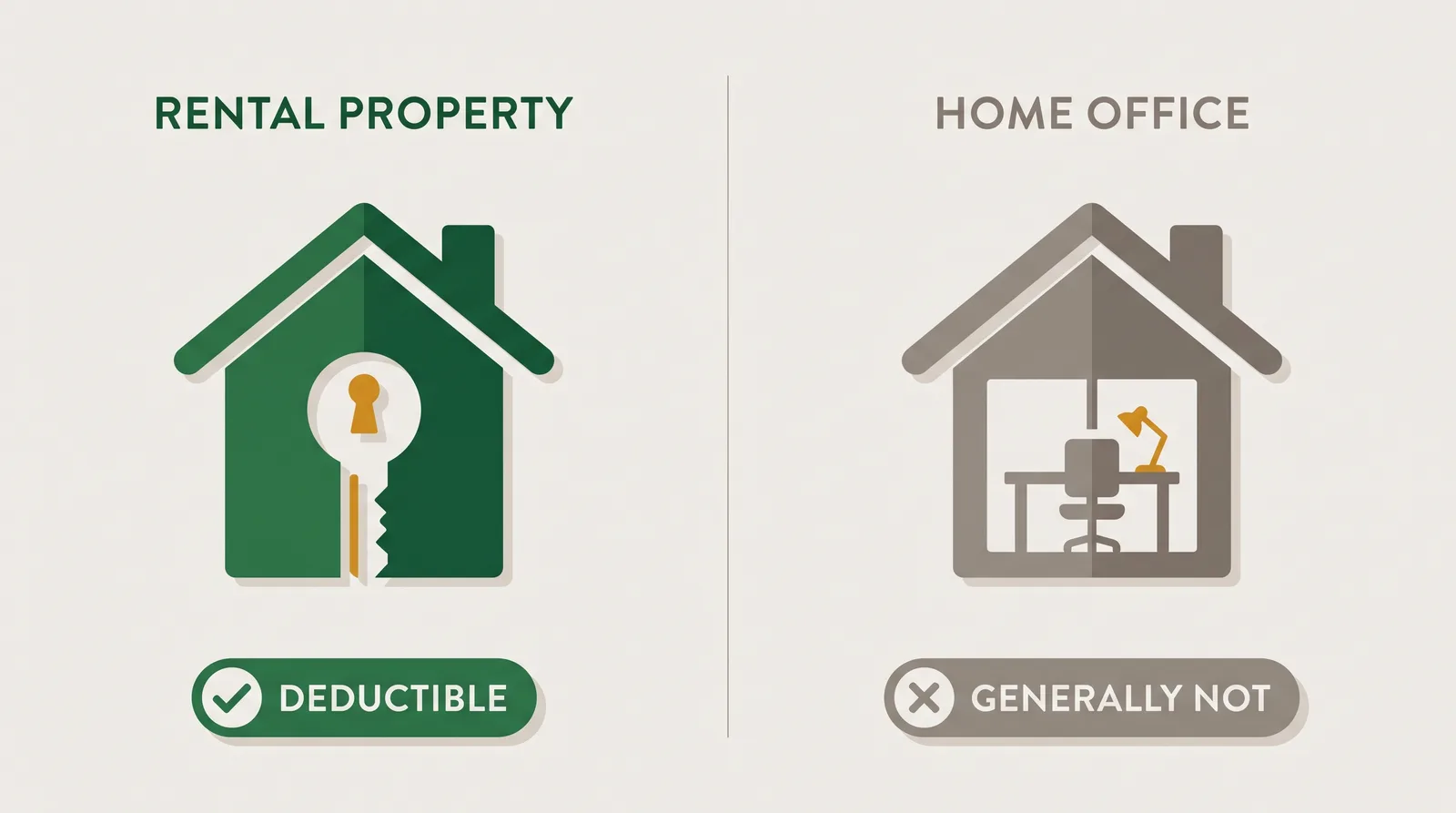
This narrow exception covers a business that actually uses the outdoor area to earn its income. A licensed home daycare whose children use the backyard is the classic example. In those cases, a reasonable share of yard-related costs can get the same business-use treatment as the indoor space. That use is specific and defensible. It is not a general "I work from home so my lawn counts" claim. If your business truly uses the grounds, record how, and ask an accountant to calculate the reasonable share.
What records does the CRA expect?
For every service you plan to claim, retain dated invoices that show the work performed and the total amount, HST included. Under CRA rules, a deduction must be claimed in the year the expense is incurred, so the date and your documents both count. An organized file of lawn care and snow removal invoices for a rental is exactly the type of current-expense record the T776 process expects.
Pay attention to one HST detail: when a service is deductible, the deductible cost includes the 13% Ontario HST. A GST/HST-registered business, however, may claim that tax as an input tax credit rather than deduct it as an expense; you cannot use both treatments. Your registration decides which treatment applies, so verify it instead of assuming.
The bottom line for GTA homeowners and landlords
You may deduct lawn care and landscaping for a property that produces rental income, and landscaping is deductible in the year you pay it, which is a real reason to keep clean invoices. For a home you occupy, the expense is not deductible, home office or not, unless a genuine business uses the grounds. Before you commit to a service for a rental, you can compare rated crews and look up current ranges on the lawn care cost page.
Do you manage a rental in the GTA and need a lawn care price that is fair, documented, and safe to deduct? Request a quote and compare offers from up to three screened local pros side by side. Only the professional you select gets your contact details, and you receive a clean invoice for your records.