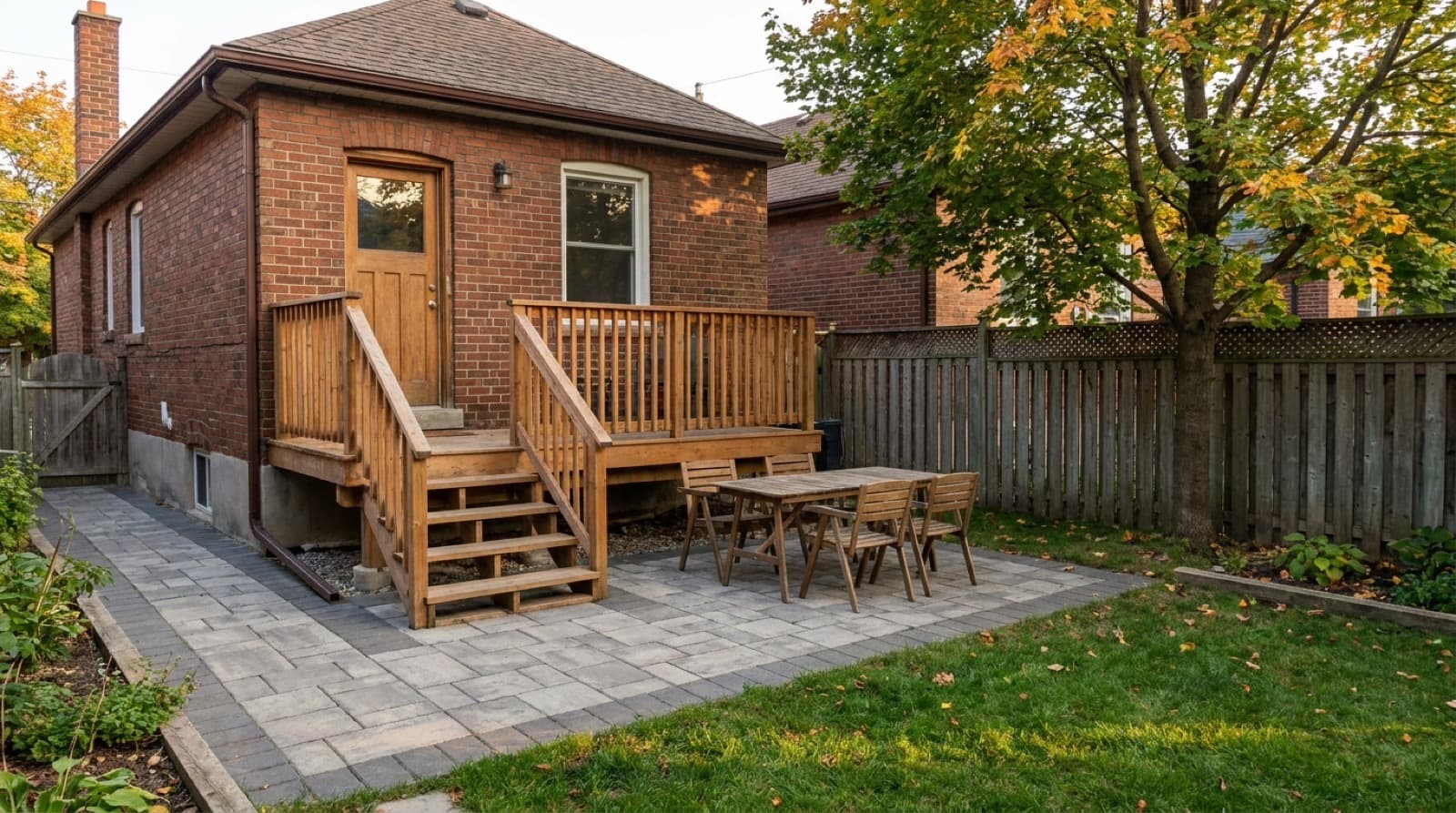
Answer First: For most Toronto backyards at ground level, an interlock patio is the cheaper and longer-lived choice: Ultrascape, a GTA installer, prices one at $18 to $30 per square foot installed. A deck makes more sense when your back door sits well above the lawn, because it reaches that height on posts instead of built-up ground.
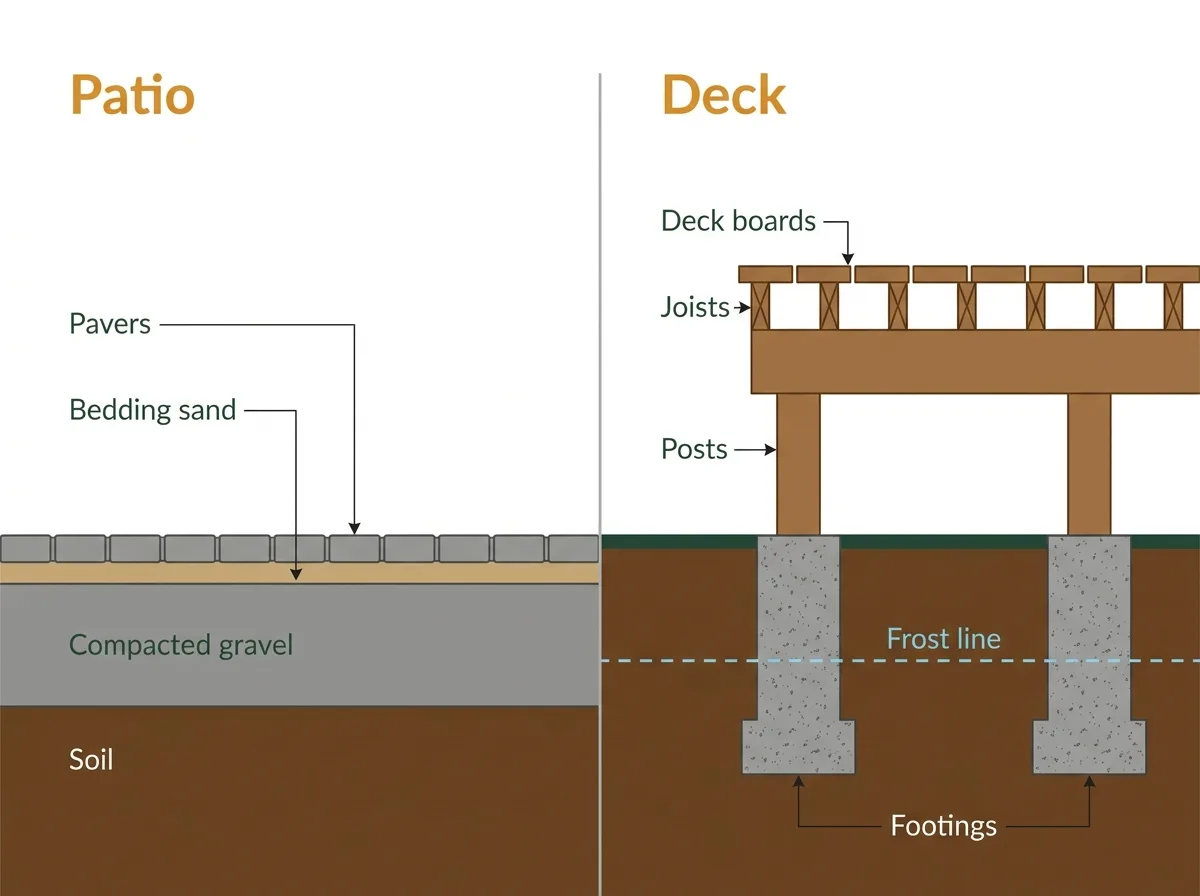
Both options put a hard, usable surface behind the house. They get there in opposite ways. A patio lies flat on a thick bed of packed gravel. A deck floats on a frame of posts and beams. That one difference drives almost everything else in this guide, from price to winter damage.
Patio stones vs a deck: which is better for a Toronto backyard?
For a yard where the back door is close to the ground, patio stones usually win on price and upkeep, and a deck wins on reaching height. Here is how the two compare on the six points that decide most jobs.
| What you are weighing | Interlock patio | Wood or composite deck |
|---|---|---|
| Installed price (Toronto) | $18 to $30 per sq ft (Ultrascape) | $30 to $50 pressure-treated, $55 to $80 composite per sq ft (Decks For Life) |
| Lifespan stated by a named source | 30 to 50 years for a well-built interlock driveway (GTA Sunrise) | 10 to 15 years for pressure-treated wood with proper care (Decks For Life) |
| Routine upkeep | Joint sand and optional sealer every few years | Stain or sealer every 2 to 3 years on pressure-treated wood |
| Freeze-thaw weak point | The gravel base under the stones | The footings and any wood that stays wet |
| Best height | At or near grade | Above grade, up to the back door |
| Look | Stone, many colours and patterns | Wood grain or composite boards |
In the table, grade means the ground level of your yard. The rest of this guide explains each row. If you already know your door height, skip to the section on height, because on many lots that decides it.
How much does a patio cost compared with a deck in Toronto?
A patio usually costs less per square foot. Ultrascape, a GTA installer, puts an installed backyard interlock patio at $18 to $30 per square foot, and $22 is the typical figure in the Toronto interlocking cost guide we keep. Most of that is labour and base work, not stone: the same Ultrascape guide lists standard concrete pavers at $5 to $8 per square foot for material alone, and premium brands at $12 to $20.
Decks are a different story. YardGrade has no deck price dataset of its own, so the deck numbers here come from one Toronto builder's published guide, not from our research. Decks For Life, a Toronto deck builder, lists $30 to $50 per square foot installed for pressure-treated wood and $55 to $80 for composite, and says those prices cover materials and labour plus standard stairs, but not permits or tearing out an old deck.
Now picture a 300 square foot space, room for a table and a barbecue:
- Interlock patio: $5,400 to $9,000 at Ultrascape's per-square-foot range (our arithmetic), or about $6,600 at our guide's $22 typical figure.
- Pressure-treated deck: $12,000 to $18,000, from Decks For Life's own table for a 300 sq ft deck.
- Composite deck: $20,000 to $30,000, from the same Decks For Life table.
Ontario work carries 13% HST (Canada Revenue Agency), so check whether each quote includes it before you compare.
Quotable: In Toronto, Ultrascape's installed interlock patio range tops out at $30 per square foot, the same price where Decks For Life's pressure-treated deck range begins, so at ground level a paver patio is normally the lower quote.
Which lasts longer, interlock pavers or a wood deck?
Interlock usually lasts longer, but only when its base is built right. GTA Sunrise, an Ontario paving company, says a properly built interlock driveway "will serve without any problems for 30-50 years." A patio is built lighter than a driveway: Ultrascape notes that most guides call for 60 mm pavers on patios and 80 mm on driveways. No source we checked gives a separate patio figure.
On the deck side, Decks For Life gives pressure-treated wood a "shorter lifespan (10-15 years with proper care)." The Canadian Wood Council is more open-ended. Its treated wood FAQ says treated wood "can last virtually as long as you want it to, given the correct specification, quality control and installation." Both statements can be true. A deck's life depends heavily on how it was built and how well it has been kept up.
Cedar is sometimes pitched as the longer-lasting wood. The Canadian Wood Council says the heartwood of species like western red cedar resists decay "to some degree, but it is variable," and that wood treated to CSA standards delivers more reliable durability on average.
How do Toronto freeze-thaw winters treat each one?
Each one fails from the bottom up, not from the top down. Concrete pavers themselves handle winter well. The Concrete Masonry & Hardscapes Association says "the high density of a paver limits deicing material from entering" and that "a high cement content helps a paver resist damage from the stress of expanding ice."
The trouble starts underneath. Khan Scapes, a Toronto company citing the Interlocking Concrete Pavement Institute, names three reasons pavers sink: a base that was not packed down enough, missing edge restraints (the border strips or stones that stop pavers creeping outward), and bedding sand washed out by water. It adds that GTA freeze-thaw cycles make all three worse every year. Ultrascape says patios typically need 6 to 8 inches of excavation for the base, and says "poor base work is the most common reason homeowners face premature repairs." That makes base depth the first line to compare across quotes.
A deck moves the problem to its footings and its wood. The City of Toronto's deck permit guide asks for drawings showing footing depth and "frost protection details," which tells you where the risk sits. The wood itself suffers from moisture, which is why the upkeep section below is mostly about keeping water out of it. A footing is the concrete pad or pier, set in the ground, that each deck post stands on.
Compare how two other hard surfaces handle the same winters in our interlocking vs concrete comparison.
What upkeep does each one need?
A patio needs attention every few years; a wood deck needs it more often. For pavers, JHC Landscaping, a Toronto company, charges $1.35 to $2.50 per square foot for a sand-and-seal visit (power wash, fresh polymeric sand, then sealer) and says its sealant "lasts up to 5 years." Where you salt in winter, Khan Scapes suggests refreshing the joints every 2 to 3 years, because salt breaks down polymeric sand faster.
Polymeric sand is a sand swept into the joints between pavers that sets hard; Ultrascape says it is used "to harden joints, preventing weed growth."
For wood, Decks For Life says pressure-treated decks need "staining or sealing every 2-3 years." Wood Preservation Canada says "any exposed wood, pressure treated or not, should be protected from the weather," and that you can apply a water repellent or semi-transparent stain once the wood is dry to the touch after installation. It also says every cut and hole "should be brush-coated with two applications of a registered end-cut preservative," because a cut exposes untreated wood. Decks For Life says composite (boards made from wood fibre and plastic) needs "no staining," but at $55 to $80 per square foot on its list, you pay for that up front.
When does your back door height decide it?
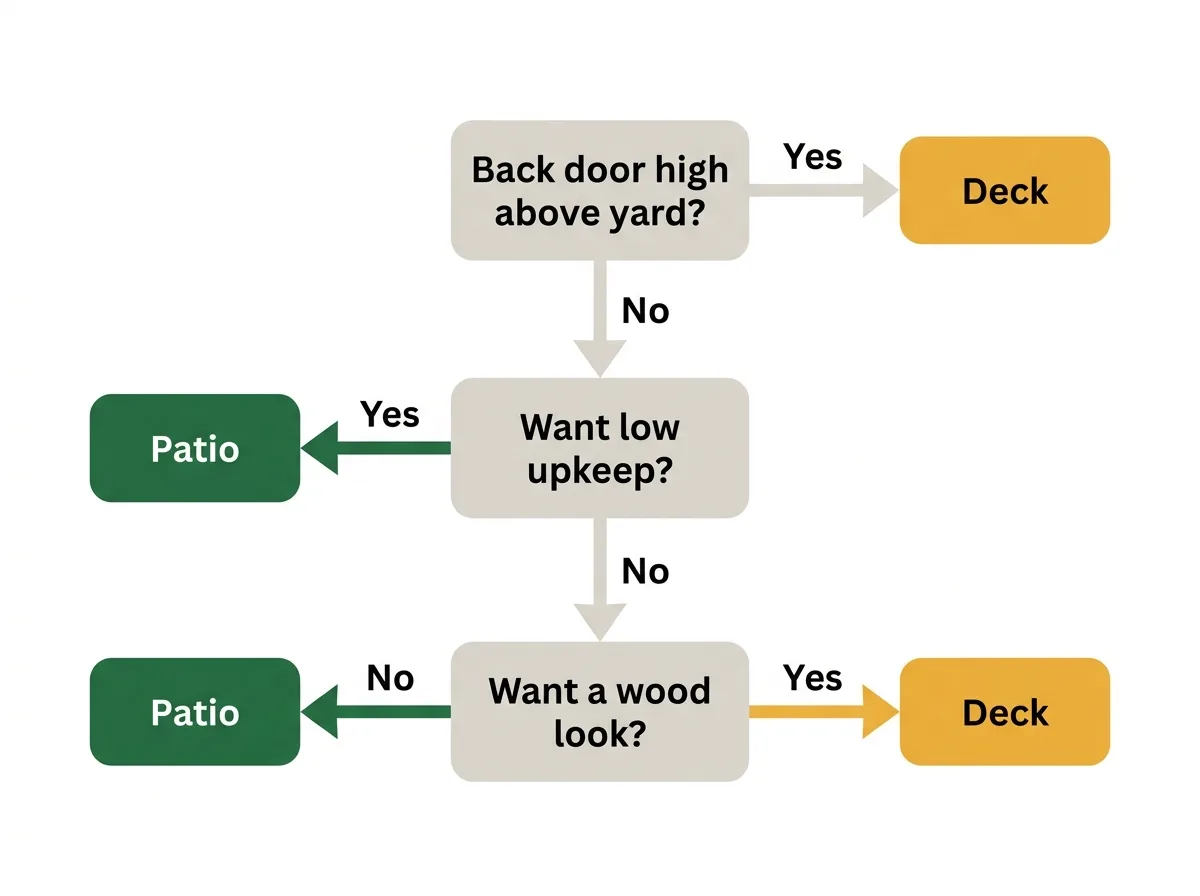
If your back door opens several steps above the yard, a deck is usually the practical answer. A deck reaches the door on posts, keeps a walk-out level with the kitchen, and leaves the ground beneath open. A patio at that height means raising the ground itself, with walls and fill, which adds cost and a second project.
If your back door is at or near the lawn, the patio wins, because there is no height to make up and it avoids a frame that needs finishing every few years. Some lots sit in between, with a door three or four steps up. A small landing deck with stairs down to a paver patio is one way to split it.
Height also changes the paperwork. The City of Toronto says you need a building permit to construct a deck more than 60 centimetres (24 inches) above ground. This guide is a plain summary, not legal advice, so confirm your own project with Toronto Building.
Who builds patios and decks in Toronto?
Far more Toronto companies list interlocking work than deck building, and a smaller group does both. That matters if you want a landing deck and a patio in one job.
From the data: Of the 947 Toronto listings we track, 438 are in the interlocking category and 65 are in fencing and decks. Only 48 appear in both. We counted each listing's categories and city in our listings file on September 22, 2026.
You can browse the Toronto interlocking companies and the Toronto fencing and deck companies we track, each ranked by the same published formula. If the budget is tight, our guide to backyard landscaping on a budget covers where the money goes furthest.
So should you build a patio or a deck?
Build a patio if your door is near the ground and you want the lower price and the longer, lighter upkeep cycle. Build a deck if the door sits well above the yard, or if you want wood underfoot and accept renewing its finish every few years. On a split-level lot, a small deck with a patio at the bottom of the stairs can beat either one alone.
YardGrade is free for homeowners; contractors pay for the introductions we make, as our about page explains, and no company can pay for a better grade.
Whichever you pick, the foundation decides how it handles Toronto winters, so compare quotes on base depth and footing details, not only the total. Request quotes from up to 3 local pros and compare them side by side before you choose.