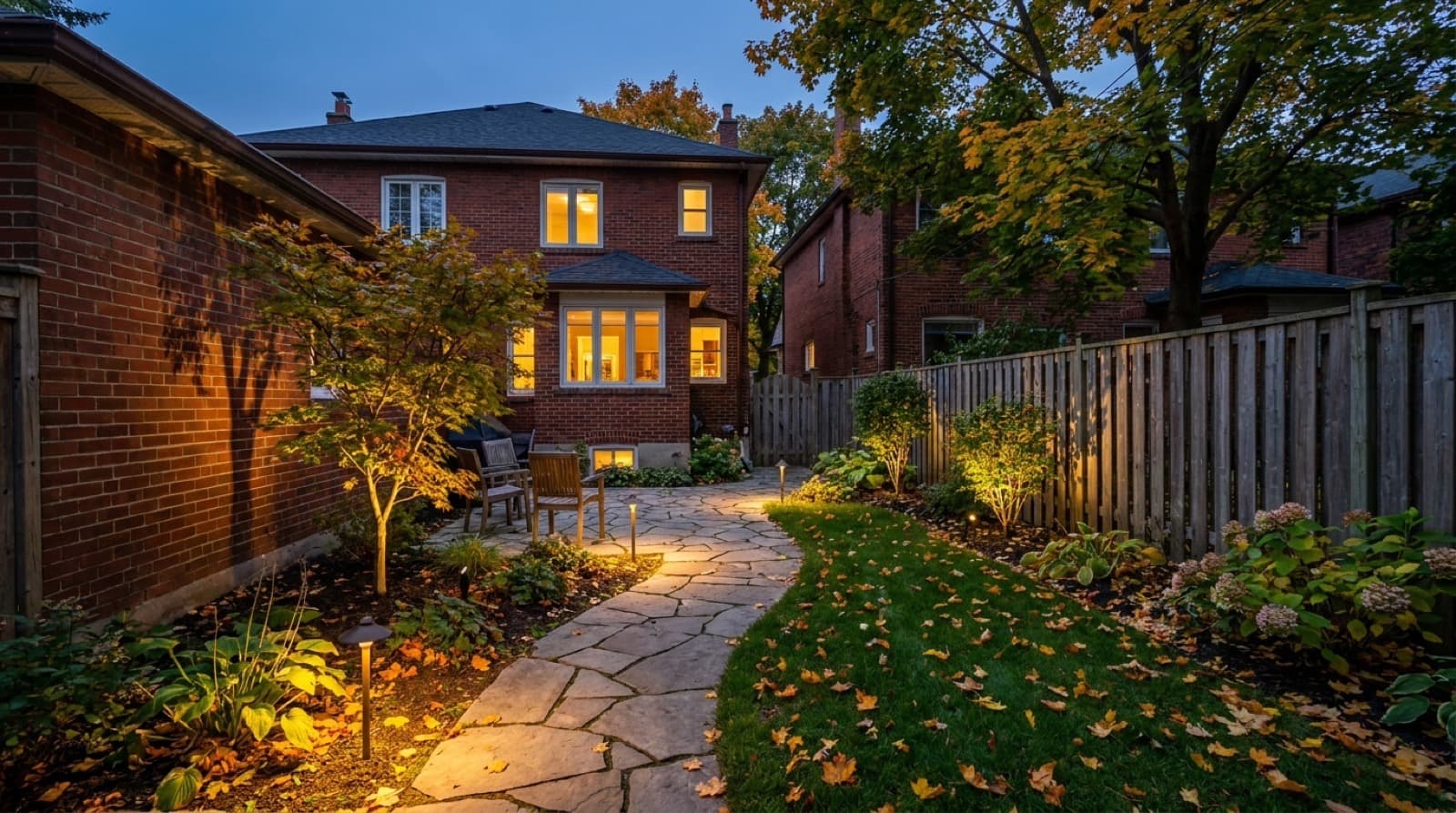
Answer First: Plan on filing a notification with the Electrical Safety Authority (ESA). ESA says almost all electrical work must be reported before it starts, and its May 2025 bulletin does not extend the low-voltage exemption to light fixtures. Only you, in your own home, or a Licensed Electrical Contractor may wire it. Book free Ontario One Call locates before digging.
Most homeowners assume a plug-in path light kit from a hardware store needs no paperwork. ESA's published rules do not say that. The sections below show exactly what they do say, where the grey area sits, and what to do before a shovel goes into your yard.
This article explains public rules in plain words. It is not legal advice, and ESA has the final say on your project, so confirm with them before you start.
Do you need a permit for landscape lighting in Toronto?
For the electrical side, the answer comes from the province, not the City. In Ontario an electrical "permit" is called a notification of work, and you file it with ESA. According to ESA's notifications page, the Ontario Electrical Safety Code "requires almost all electrical work be reported to the Electrical Safety Authority by filing a notification of work." The person doing the work, you or a Licensed Electrical Contractor, should file it before the work starts.
ESA adds a line that trips people up: "Having a building permit isn't the same as filing an electrical notification. You may need both." If your lighting is part of a larger job, such as a new deck, ask about the City side separately.
Once the work is reviewed and passes, ESA issues a Certificate of Acceptance to whoever filed. ESA calls it an important document for insurance purposes and resale. Of everything in this process, that certificate is what you will want to have later.
Quotable: In Ontario, the "permit" for landscape lighting is an ESA notification of work, filed before the work starts. ESA's May 2025 code bulletin excludes luminaires and decorative lighting strips from its low-voltage exemption, so a lighting kit is not automatically exempt.
Does a plug-in low-voltage kit need an ESA notification?
ESA does not give plug-in garden lights a clear pass, so plan on filing one. Here is why.
ESA's Bulletin 2-3-19, issued May 2025, lists the jobs that skip notification. One is wiring "connected to the load side of a Class 2 power supply." The load side is the wiring that runs out of the power supply toward the lights. A Class 2 power supply is a small, limited power source. The bulletin caps it at 100 VA (volt-amperes, a measure of power) and about 30 volts.
That sounds like it covers a low-voltage kit. But a note attached to that exemption says it "does not include electrical equipment such as luminaires, decorative lighting strips, signs or displays." A luminaire is the code's word for a light fixture, and a path light is a light fixture. The same bulletin also states that "All new installations require a notification to be filed regardless of the worker designation." In its table of who may skip notification, the column for a single dwelling unit owner reads "N/A" on the Class 2 row.
An earlier trade report points the same way. Landscape Ontario reported in June 2016 that ESA told its lighting sector group that "all landscape lighting installations, regardless of whether or not transformers are plugged into 120-volt receptacles, require a Yard and Garden Electrical Permit."
The same 2016 report added that a person who is not an electrician could apply for that yard and garden permit, as long as they were not changing 120-volt wiring. That describes the permit rules of 2016. ESA's current homeowner pages, quoted in the next sections, are narrower about who may do the work.
In practice, file the notification or call ESA at 1-877-ESA-SAFE, the number its notifications page gives for confirming requirements and fees, and get the answer for your specific kit.
How is a plug-in kit different from hardwired line-voltage lighting?
The difference is where the power comes from and how much wiring changes.
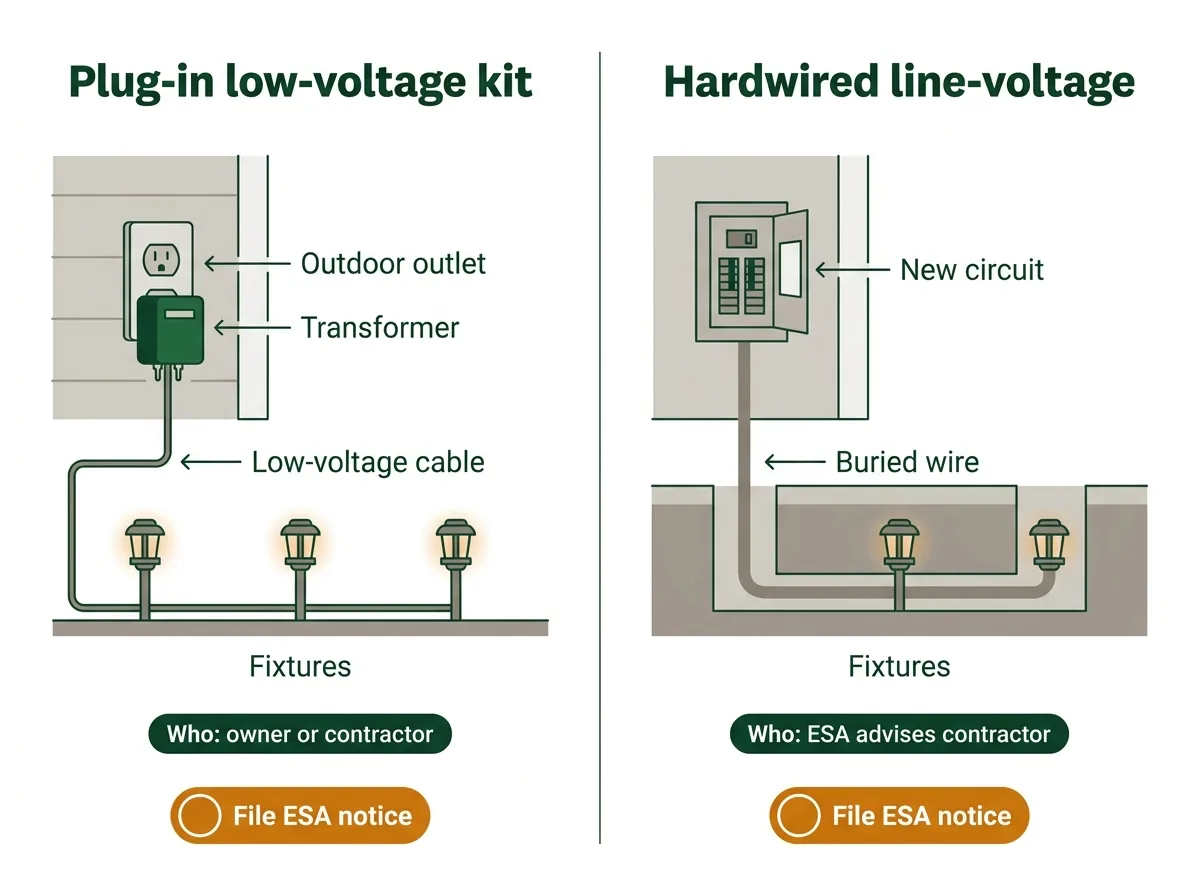
Plug-in low-voltage kit. A transformer plugs into an outdoor outlet and feeds low-voltage cable to the fixtures. ESA's backyard safety article, "Make Your Outdoors Even Greater," says low-voltage systems "require a special isolating transformer, which helps prevent shock and short circuits."
Check the outlet before you plug anything in. The same ESA article says all 120-volt 15- and 20-amp receptacles in your backyard must be protected by a Class A Ground Fault Circuit Interrupter (GFCI), the outlet with tester buttons. It also says an outlet exposed to rain or snow needs a cover plate marked "Extra Duty." If your outdoor outlet lacks either, fixing it is electrical work too, and ESA's Bulletin 2-3-19 lets only a Licensed Electrical Contractor swap a receptacle without filing a notification.
Hardwired line-voltage lighting. New wiring runs from the house to fixtures or to a new outdoor outlet. ESA's Bulletin 2-3-19 says its basic exemption "does not include installing, extending, altering or repairing of any electrical wiring," so that work needs a notification. ESA's outdoor article says getting power "all the way to your back garden" means your contractor runs the wiring through a trench. "Assuming it's low voltage lighting at less than 750 volts," it gives trench depths of 60 to 90 centimetres where the trench crosses a driveway and 45 to 60 centimetres where it stays in the yard.
Who is allowed to install landscape lighting wiring?
You can, in your own home, and so can a Licensed Electrical Contractor. ESA's current pages name no one else.
ESA's DIY electrical work page says "Only you can do electrical work in your home, but you must file a notification with ESA," and "Friends, family members or neighbours cannot perform electrical work in your home." ESA says fees vary with the job, but for many small residential projects they can be less than $100. ESA also tells homeowners not to conceal the work before ESA has reviewed it.
If you pay someone, ESA's notifications page says that "by law, it must be a Licensed Electrical Contractor (LEC)." If a landscaper or general contractor is running the whole yard project, ESA says to confirm that a Licensed Electrical Contractor will do the electrical work. ESA's page on hiring a Licensed Electrical Contractor says to ask for their ECRA/ESA licence number (ECRA stands for Electrical Contractor Registration Agency) and verify it on ESA's Find a Contractor tool. Also ask, in writing, who files the notification and whether you will get a copy of the Certificate of Acceptance.
From the data: YardGrade's Toronto directory holds 15 companies in the landscape lighting category. Ten of those 15 also appear under lawn care. The 14 lighting listings with at least three reviews average 4.89 stars on Google. We hold no price research for this category, so this article quotes no lighting prices.
YardGrade is free for homeowners; contractors pay for the introductions we make, as our about page explains, and no company can pay for a better grade.
Those overlaps are one more reason to ask who handles the wiring. You can browse the full landscape lighting directory or the wider list of Toronto landscaping companies, then ask whoever you shortlist for that licence number. YardGrade does not check licences.
What should you check before digging trenches for cable?
Request locates first, then keep every trench open until the wiring has been reviewed.
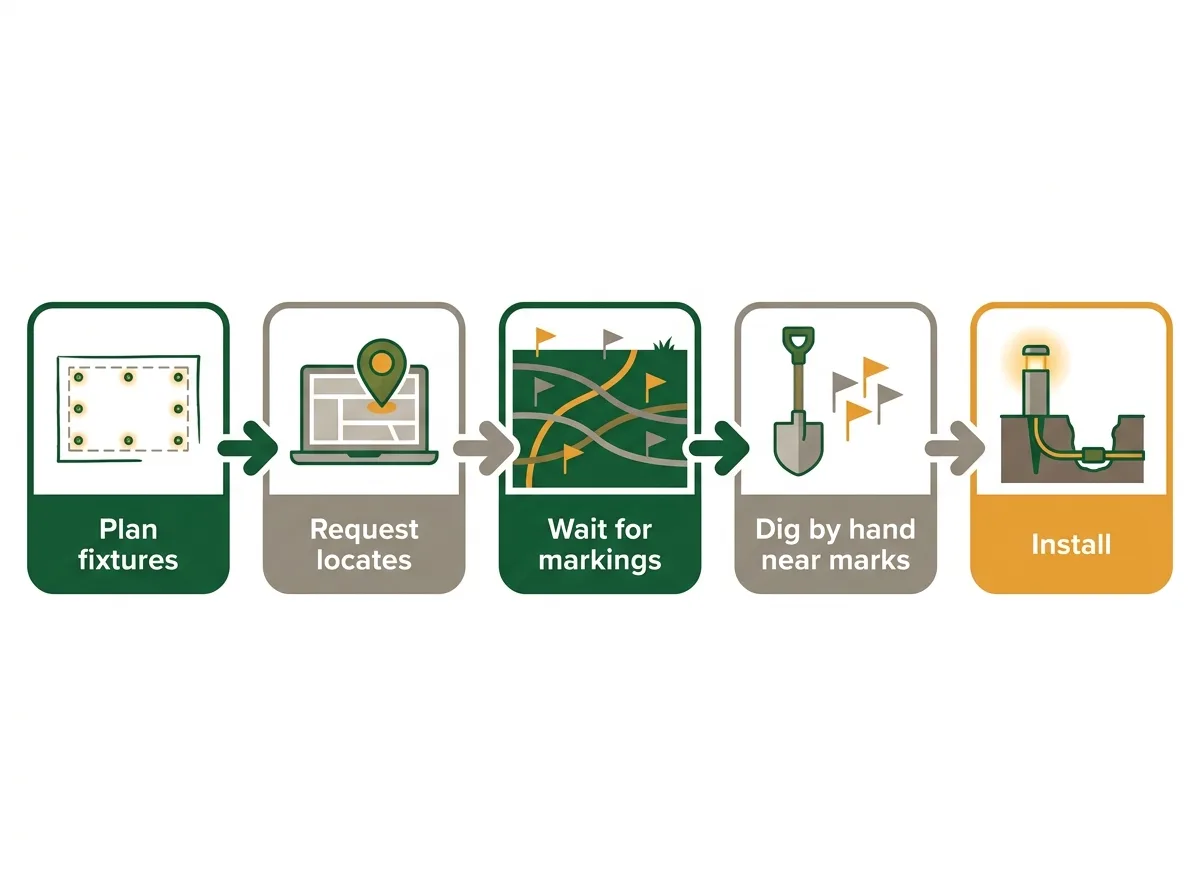
- Plan fixture spots and the cable route on a sketch, so your locate request covers the right area.
- Request locates from Ontario One Call. It says homeowners must contact it "at least 5 business days before" digging for a garden or similar project, adding: "It's free, it's easy, it's the law." Requests are placed online through its web portal.
- Wait for the markings. Each utility sends locators who mark buried lines with paint, stakes or flags. Ontario One Call says all notified owners must respond before you are allowed to dig, and locates are valid for at least 60 days.
- Hire a private locator for your own lines. Ontario One Call does not mark private lines. Its list of lines a homeowner must have marked privately includes "lights or signs on the property," electrical lines out to a shed or detached garage, and gas lines to a barbecue or pool heater. If you are adding to an existing lighting system, that first item is your old cable.
- Dig by hand near the marks. Each owner's paperwork tells you how to dig around its lines; Ontario One Call's own example reads "Dig by Hand within 1 meter of the markings."
- Leave the trench open until ESA's review. ESA says an installation "must be inspected before it's concealed or buried."
On heavy Toronto clay, hand digging is slow work. If the trench is long or crosses a driveway, an excavating company in Toronto can quote the digging while the electrical contractor handles the wiring.
What are good backyard landscaping lighting ideas for a Toronto yard?
Start from the layout and let the paperwork follow. ESA's outdoor article suggests a layered scheme: sconces near doors and changes in flooring, then path lighting or lights aimed up into foliage. Common outdoor landscaping lighting ideas that fit a narrow city lot include:
- Path lights along a walkway to the side gate or garage.
- Uplights at the base of a shrub or small tree to throw shadows on a brick wall.
- Step and deck lights where a level changes.
- Overhead string lights for a patio. ESA recommends taking them down once patio season is over to prevent weather damage.
Put lighting on the plan before the patio or planting goes in, so cable can run while the ground is already open. Our backyard landscaping ideas for Canadian yards and the budget backyard guide cover the rest of the layout. For design fees, see landscape design costs in Toronto, and for the wider project, landscaping costs in Toronto.
The bottom line
Treat yard lighting as electrical work. File an ESA notification or confirm by phone that your kit is exempt, since ESA's written rules do not exempt light fixtures. Use a Licensed Electrical Contractor for anything hardwired unless you are doing it yourself in your own home. Book Ontario One Call locates before any trench, and leave the trench open until ESA has reviewed it.
Planning lighting as part of a bigger yard project? Request quotes from up to 3 local pros, compare them side by side, and ask each one who files the ESA notification.